
LogIQ Music Streaming Server
Press Play. The Field Follows.
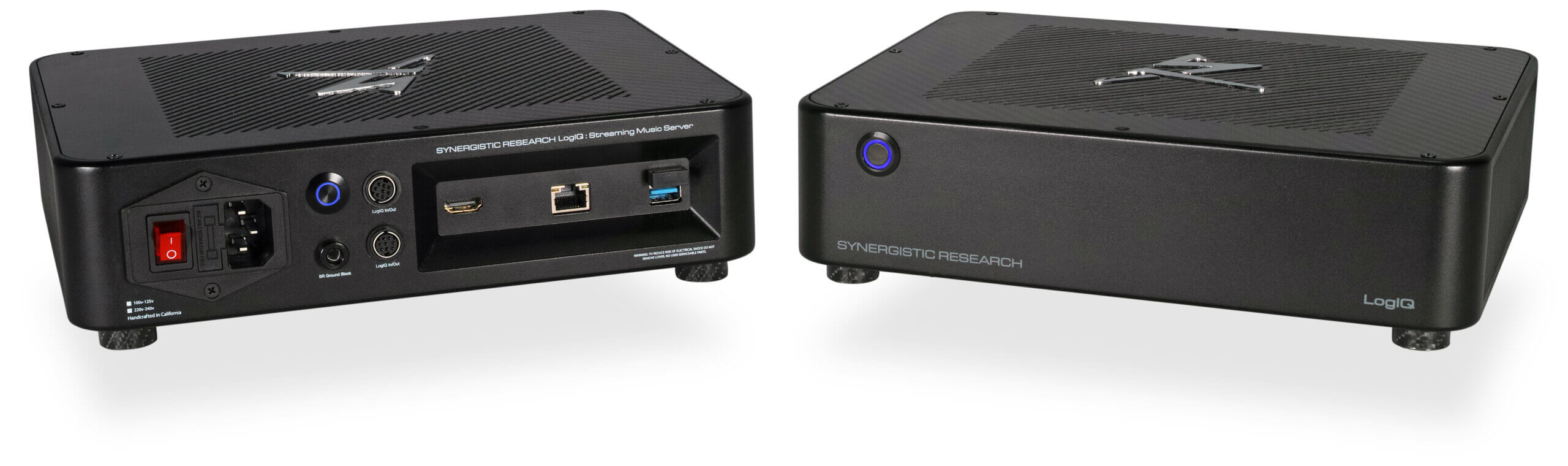
A Roon music server with a built-in LogIQ field that sets the electromagnetic environment inside the server to every track you play. The field never touches the signal path. No DSP. Every bit unchanged.
Every recording carries the intention of the people who made it. LogIQ reads each track from Roon and sets a field environment that lets that intention come through, something a chaotic MHz–GHz environment never allows. Then you shape it. Say “deeper soundstage” in plain language and the stage deepens. Tighter bass. More layering. Done, while the music plays, without changing a single bit.
Other server makers are still building a better PC. We built the best PC we could, then built the environment it operates in, set to every recording you play.
Arrange a home audition.
Most Servers Are Just Computers.
Every streaming server starts as a computer built to do one job: deliver files to your DAC. Most never become anything more. Some of them are very expensive computers. All of them generate what every computer generates, MHz–GHz switching noise, and with it the flat, two-dimensional sound digital has been blamed for since the day it arrived.
The LogIQ Music Streaming Server starts from a different idea. The PC inside is the best we could build without going to obscene lengths. The rest went into technology you won’t find in any server outside Synergistic Research: patented Electromagnetic Cells working directly on the circuit, a carbon fiber architecture that keeps the noise in and lets the field out, and, in this server alone, a LogIQ field set to every recording you play, automatically, from Roon.
Compare it with the most expensive servers in the world. Pick the one that sounds most like live music to you.
Digital Was Never the Problem
For decades, digital’s flatness has been blamed on the format. It isn’t the format. It’s a byproduct of the circuit. The chips that make digital audio possible generate MHz–GHz noise, and that noise imposes itself on the music on its way to your speakers. It presents as flatness. A voice that should occupy the room sits between the speakers like a cardboard cutout.
No amount of money spent on a better computer fixes that, because a better computer still computes. Faster processors, linear supplies, lower-jitter clocks, galvanic isolation. Each is an incremental improvement built on top of a fundamental compromise. Spend more and you get a more refined version of the same compromise. We are the only company in the world addressing that compromise in the field the circuit operates in, inside the server itself, set to every recording you play.
Deal with that, and digital doesn’t just close the gap with analog. It surpasses analog in exactly the places analog was supposed to own: naturalness, extension, three-dimensional staging, ease. In our own reference room, once digital crossed that line, we started hearing things in our turntable we’d tolerated for decades. Bearing noise. Motor artifacts. With digital doing what analog did best, better, they had nowhere left to hide. Streamed through the LogIQ Music Streaming Server, digital sounds like a tape deck playing a master.
One Setting, Every Recording
One Voicing Was Never Enough
Every streaming server we’ve built carries an ELF/ULF field generator, using technology we first developed for our PowerCell line conditioners and Active Ground Blocks. Every one of them also asked you to choose its setting by hand. Voodoo and Quark give you three. Blue for most listening. Green for a more forward midrange with added bass weight. Red for recordings mixed with deep phase information. They were the best settings we could find. They were also a compromise.
There are more than a trillion possible field states. Blue, Green and Red distilled all of that into three choices. So you got up between tracks to switch, or more likely you didn’t, and the string quartet and the electronic record played through the same setting. And even when you chose the right one, it was a broad approximation of what that recording wanted, nowhere near as articulate as it could be.
LogIQ ends the compromise. A server that knows exactly what it’s playing shouldn’t choose between three settings. It should choose from all of them.
The LogIQ Music Streaming Server does. It reads each track’s metadata from Roon, and the LogIQ algorithm inside the server arrives at a Meta Setting bespoke to that recording. Acoustic recordings keep their intimacy and air. Large productions open into the space they were mixed for. Across an evening of shuffled listening, the stage never resets to a compromise between tracks.
Press play. Roon names the track. The field follows.
Source Conditioning
Other Servers Filter. This One Corrects.
Every streaming server is a computer, and every computer generates MHz–GHz switching noise as a byproduct of computing. The data arrives intact. The noise doesn’t stay in the box. It leaves through your USB cable and power cord, couples into every conductor nearby, and compresses the depth and timbre of the music before it reaches your speakers. Filtering downstream treats the signal after the damage is done.
We approached the problem the way we approach a power line. The server carries the same patented Electromagnetic Cells we build into our PowerCell line conditioners and Active Ground Blocks, working directly on its DC supply and computer circuitry. They don’t filter. They project a coherent field that corrects the effect of the switching noise inside the chassis, at its source. No server outside Synergistic Research contains them.
Two more layers complete the architecture. A lower-power processing platform generates less noise to begin with, so the Electromagnetic Cells work from a quieter baseline. And the field LogIQ sets gives the signal a coherent low-frequency environment to travel through, the way a ship rides the swell rather than the surface chop.
The two do different jobs. The Electromagnetic Cells do the same job on every track, correcting the effect of the server’s switching noise. The field LogIQ sets voices that environment to the recording you’re playing, the job Blue, Green and Red once asked you to do by hand.
What reaches your cables is the music, not the machine.
What Changes. What Doesn’t.
What doesn’t change: Every bit of the data stream. The phase information. The signal path. LogIQ is not DSP, and it never touches the music.
What changes:The field environment the server’s circuitry operates in, set to each recording as it plays.
Every circuit operates inside an electromagnetic environment. Change that environment, and you change how noise interacts with the circuit, without altering a single bit.
Same data. Different environment. That’s the whole idea.
Carbon Fiber Architecture
A Membrane, Not a Shield
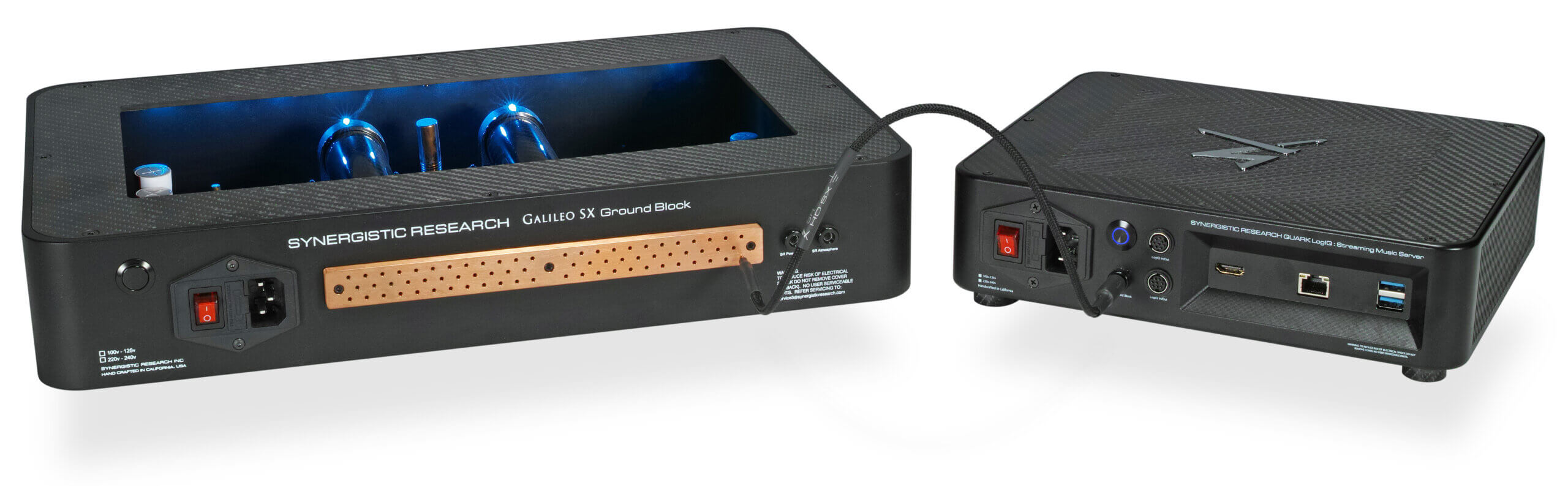
Most enclosures are designed for one job: containing high-frequency noise. The carbon fiber top panel is selective. It’s opaque to MHz–GHz frequencies, so the noise stays inside, where its effect is being corrected. It’s transparent to ELF/ULF, so the field LogIQ sets reaches the Synergistic Research cables and components around the server. The contamination stays in. The correction goes out. The selective permeability is the engineering.
Ground and Chassis
A Stable Reference in a Silent Chassis
Digital timing margins are measured in picoseconds, so ground contamination an analog stage would pass unnoticed becomes jitter in a digital one. A multi-layer UEF ground plane holds a stable reference for the circuit, and a dedicated connection extends it to an Active Ground Block. The CNC-machined aluminum and carbon fiber chassis works as a passive heat sink, so the server runs fanless and adds no mechanical or acoustic noise to your rack or your room.
The LogIQ Platform
Automatic by Default. Yours by Choice.
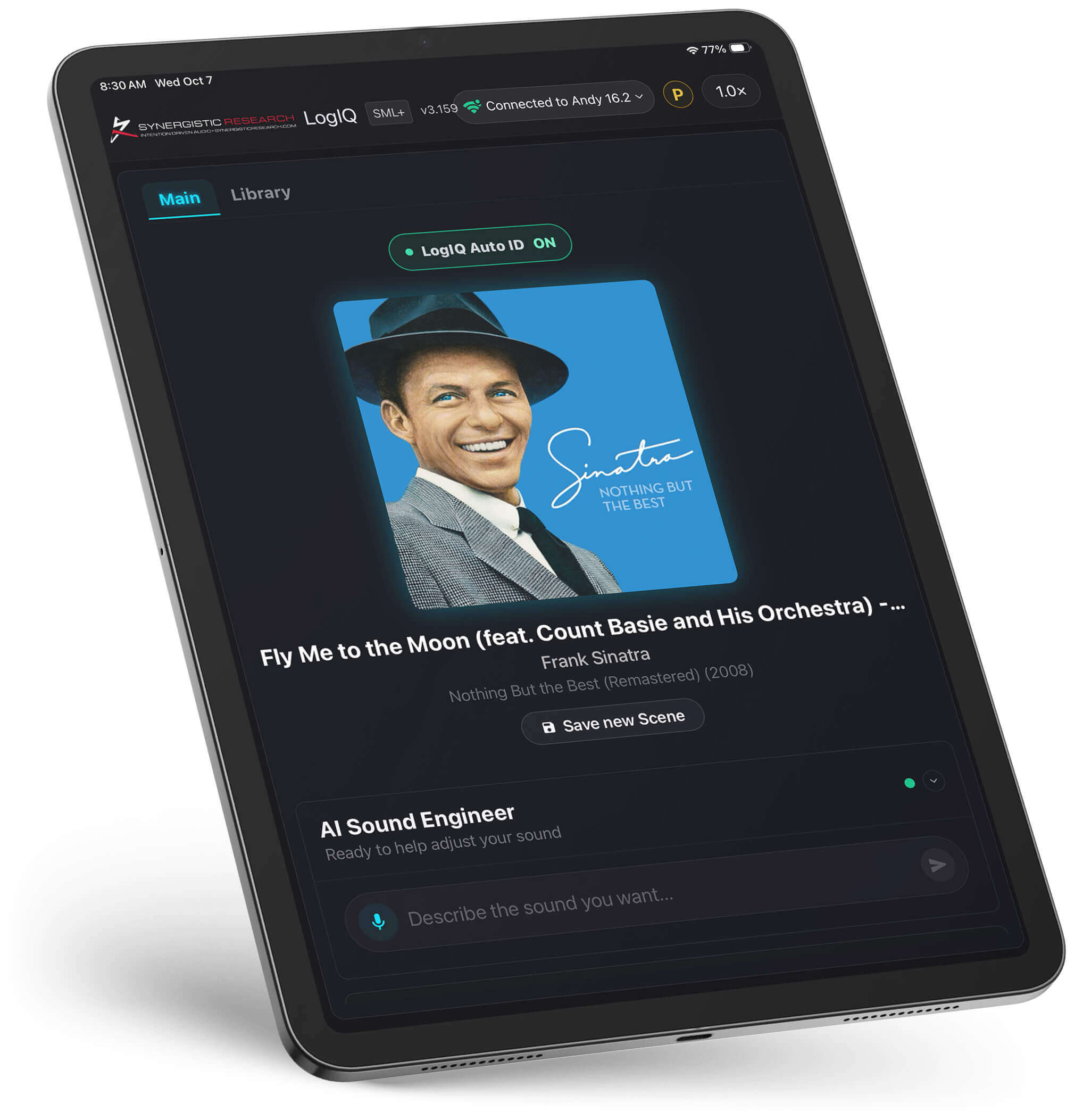
This is where the LogIQ Music Streaming Server separates from every other way to run LogIQ. Without it, you type in each artist and track. With it, you never do. Leave it to Auto ID and every track arrives voiced. Open the app and LogIQ becomes a set of tools, from a plain-language request to setting the field by hand.
Auto ID LogIQ
(LogIQ Music Server Required)
Voiced Without a Tap
Change the track and the field changes with it. The server reads each recording’s metadata directly from Roon, and the LogIQ algorithm arrives at a Meta Setting bespoke to that track. If you’ve saved your own version of that track to your Scene Gallery, your scene loads instead. LogIQ lives in the server, so nothing depends on your phone. Close the app, put the tablet away, and every track still arrives voiced. You don’t think about it. You listen.
Track Lookup
A Meta Setting for Every Recording
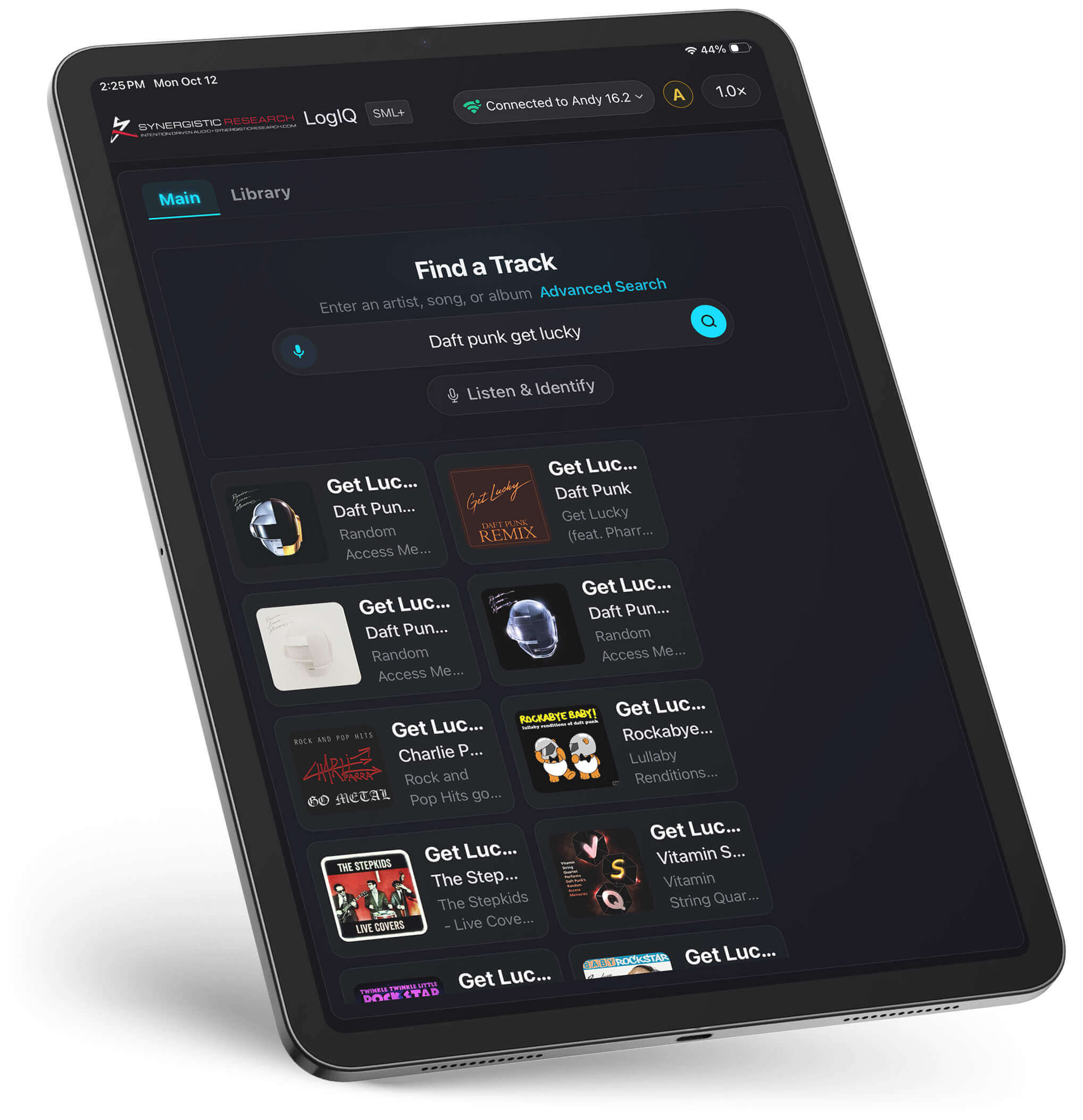
Without the server, type in the artist and track. AI searches out the recording’s metadata, you confirm the right one, and the LogIQ algorithm arrives at a Meta Setting bespoke to that track. Every Meta Setting traces back to voicing done by ear, in controlled listening. A solo cello and a dense electronic production ask opposite things of the field, so each gets its own. Pair Atmosphere LogIQ or FEQ LogIQ with the LogIQ Music Streaming Server and you’ll never look up a track again.
Saved Scenes
Dial It In Once. Hear It That Way Every Time.
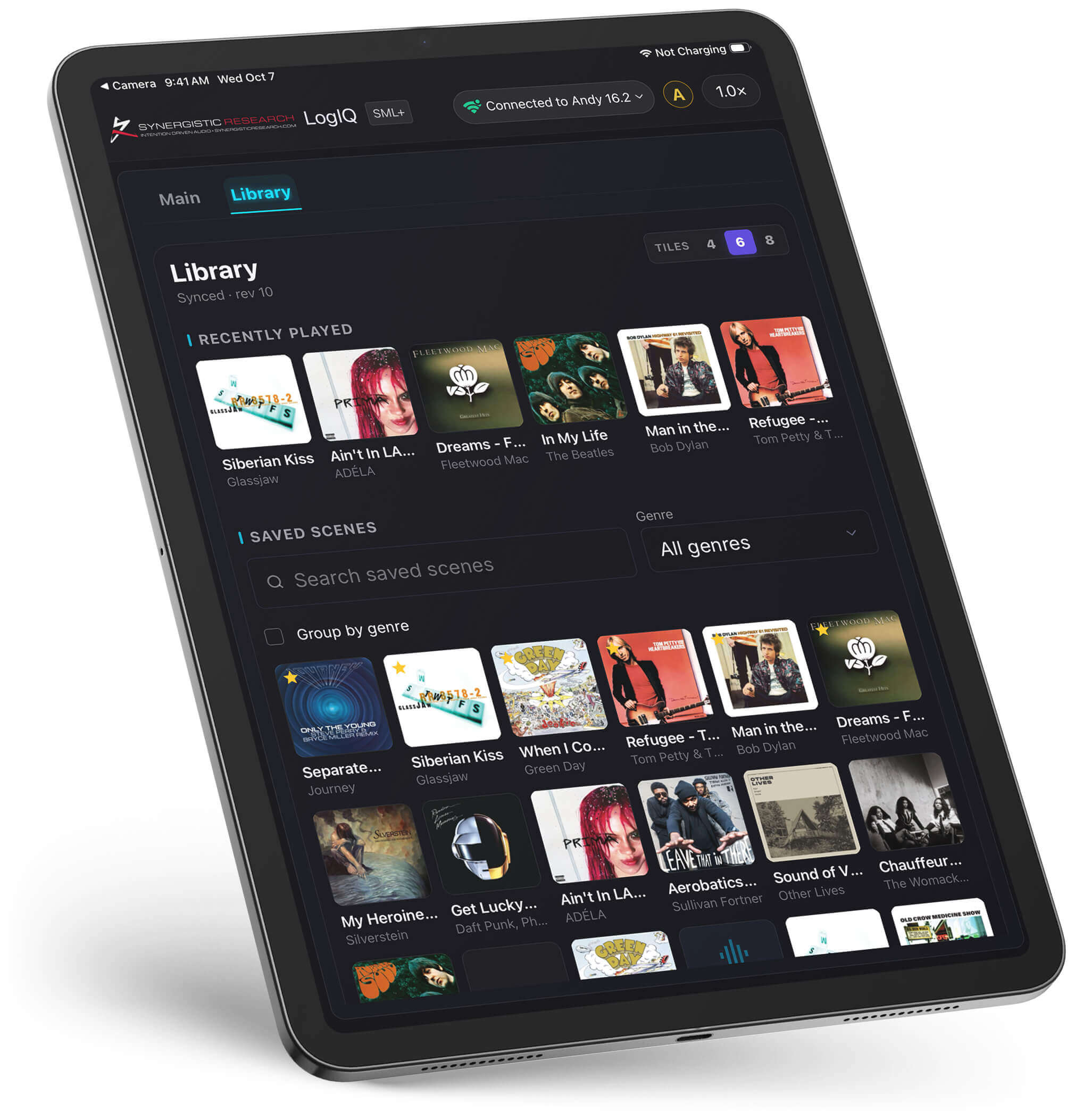
Find the setting you love and save it. LogIQ files it in your Scene Gallery under that track’s album art, and the next time the track plays, your scene loads in place of the Meta Setting, even with the app closed. Scenes are files. Move them between systems. Share them with other LogIQ owners, and an evening of careful listening becomes a single tap for someone else.
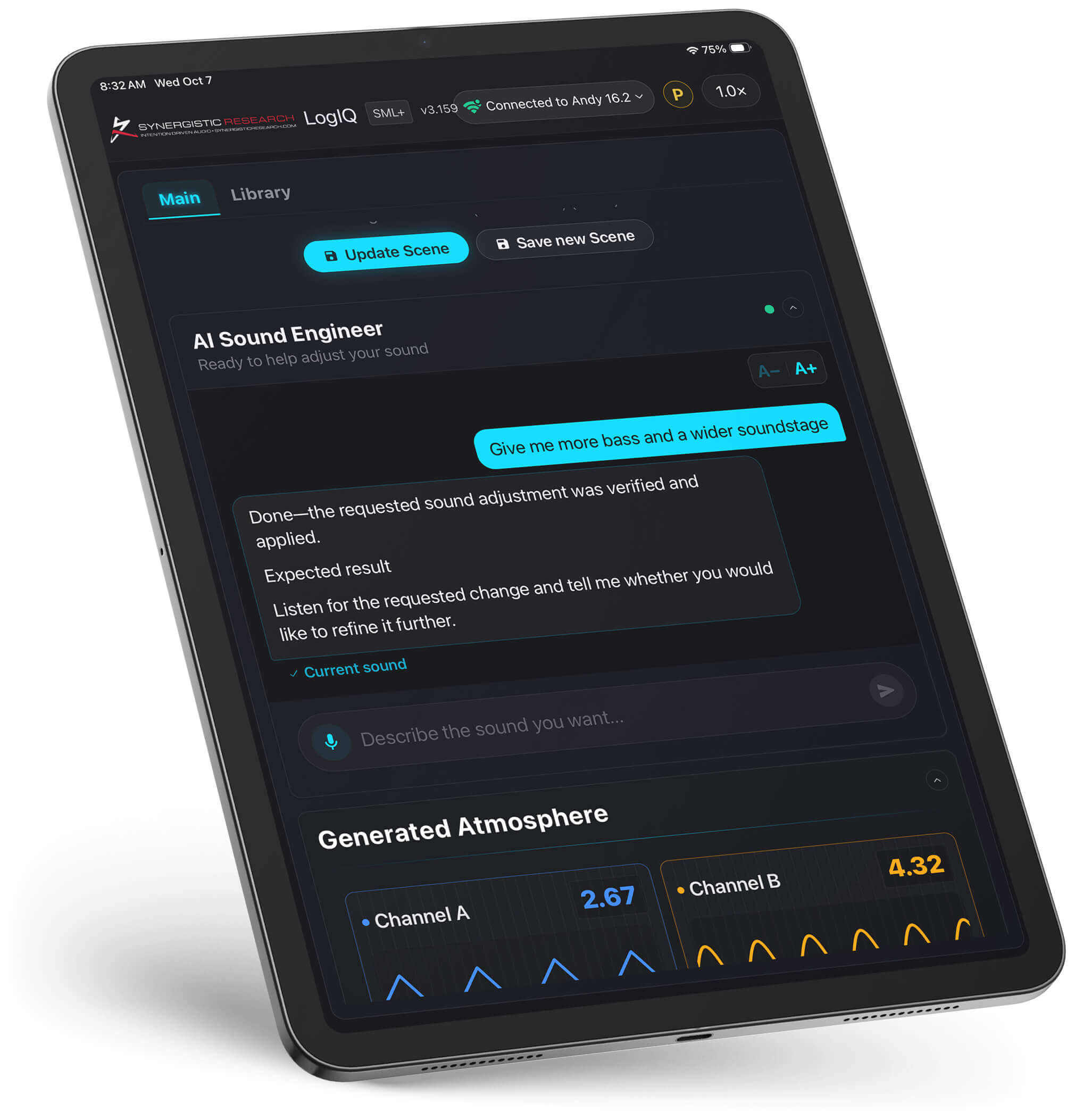
AI Sound Engineer
Just Say What You Want to Hear
Deeper soundstage. It deepens. Tighter bass. It tightens. More air. It opens. Sweeter vocals. The midrange warms. Tell the AI Sound Engineer what you want, in plain words, or tap the equivalent command. AI turns your request into a command the LogIQ algorithm understands, and the field changes to deliver it. It tells you what it changed. And it’s honest about limits. Push too far and the image starts to lose focus, so you hear exactly where a setting stops serving the music.
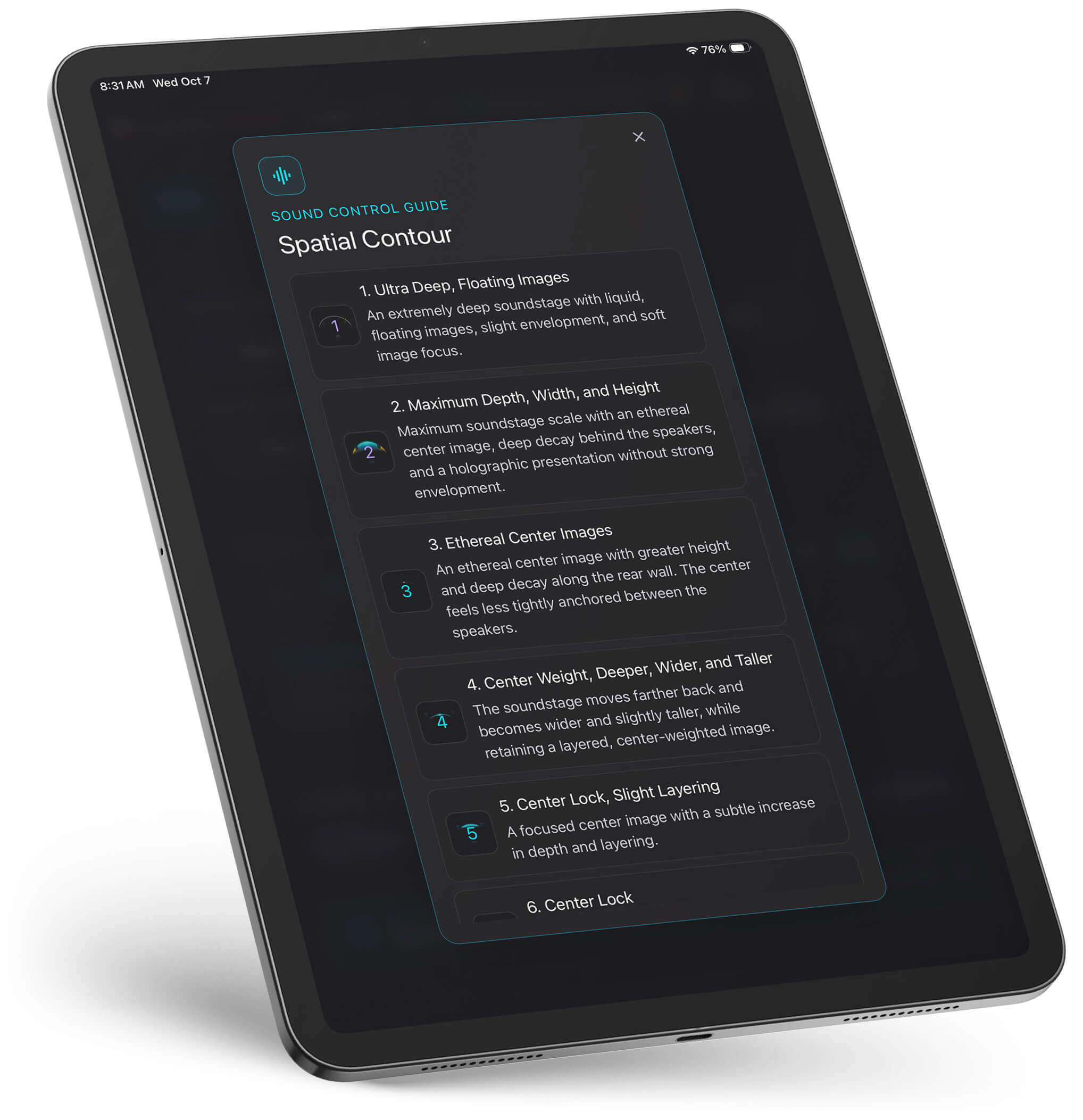
Spatial Contour
Deeper, Wider, or All Around You
When a system is right, the speakers disappear and the music forms a stage in front of you. Spatial Contour lets you shape that stage directly. Deeper, to layer performers front to back. Wider, to spread them across the room. Enveloping, to draw the field around your listening position. Choose spacious depth for a live concert or focus and immediacy for a studio session, then save it as a scene so it comes back the next time that track plays.
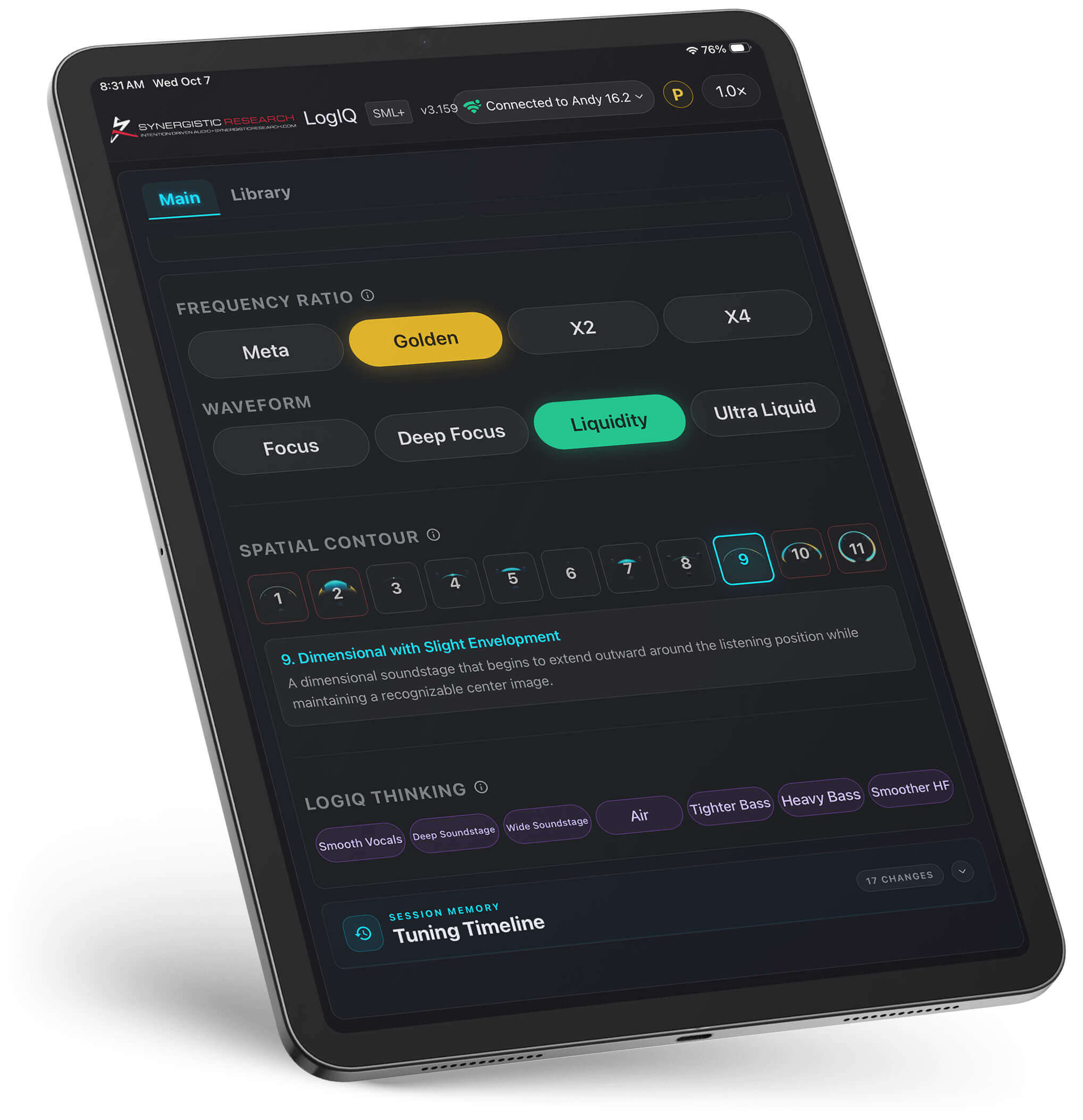
Manual Adjustment
Reach In and Set It Yourself
For the listener who wants direct control, LogIQ opens the field by hand. Set the character of the field yourself, shape the stage with Spatial Contour, and save what you find. This is where LogIQ stops choosing and you start.
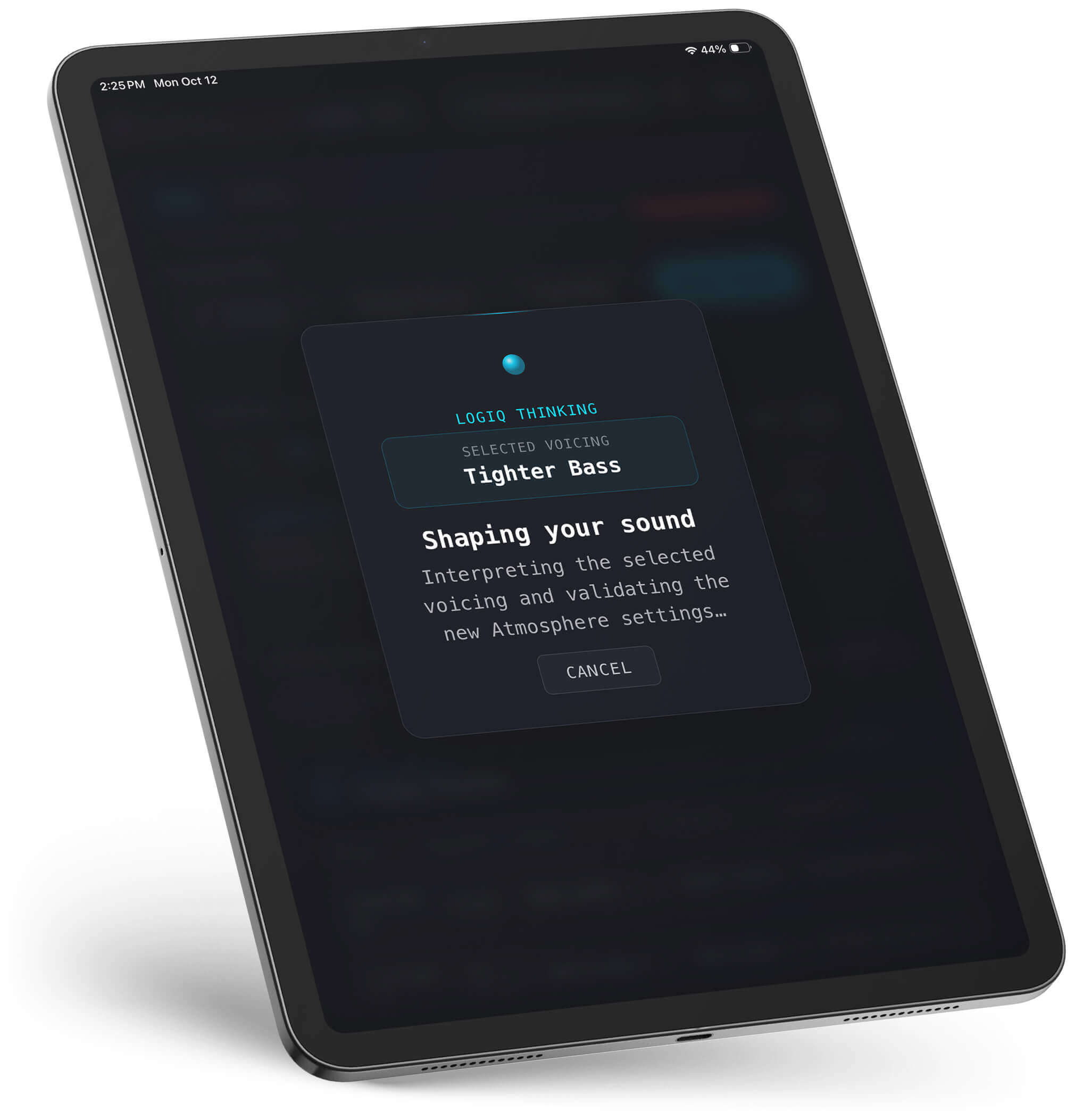
LogIQ Thinking
The More You Listen, the Less You Adjust
LogIQ Thinking is the algorithm that came out of mapping the field, built to predict how a change in the field will move the stage the way a listener hears it. From the first day, every recording arrives voiced. Your first Meta Setting for any track comes from that map and from my own voicing. It doesn’t stay mine. Tell the app what you want to hear, or tap your way there, and save what you love to your Scene Gallery. LogIQ learns from every change you save, and your Meta Settings recalibrate to your system, your room and your preferences instead of my ears and my room. Keep saving, and within three to four months you’ll find yourself adjusting very little. LogIQ becomes uniquely your own.
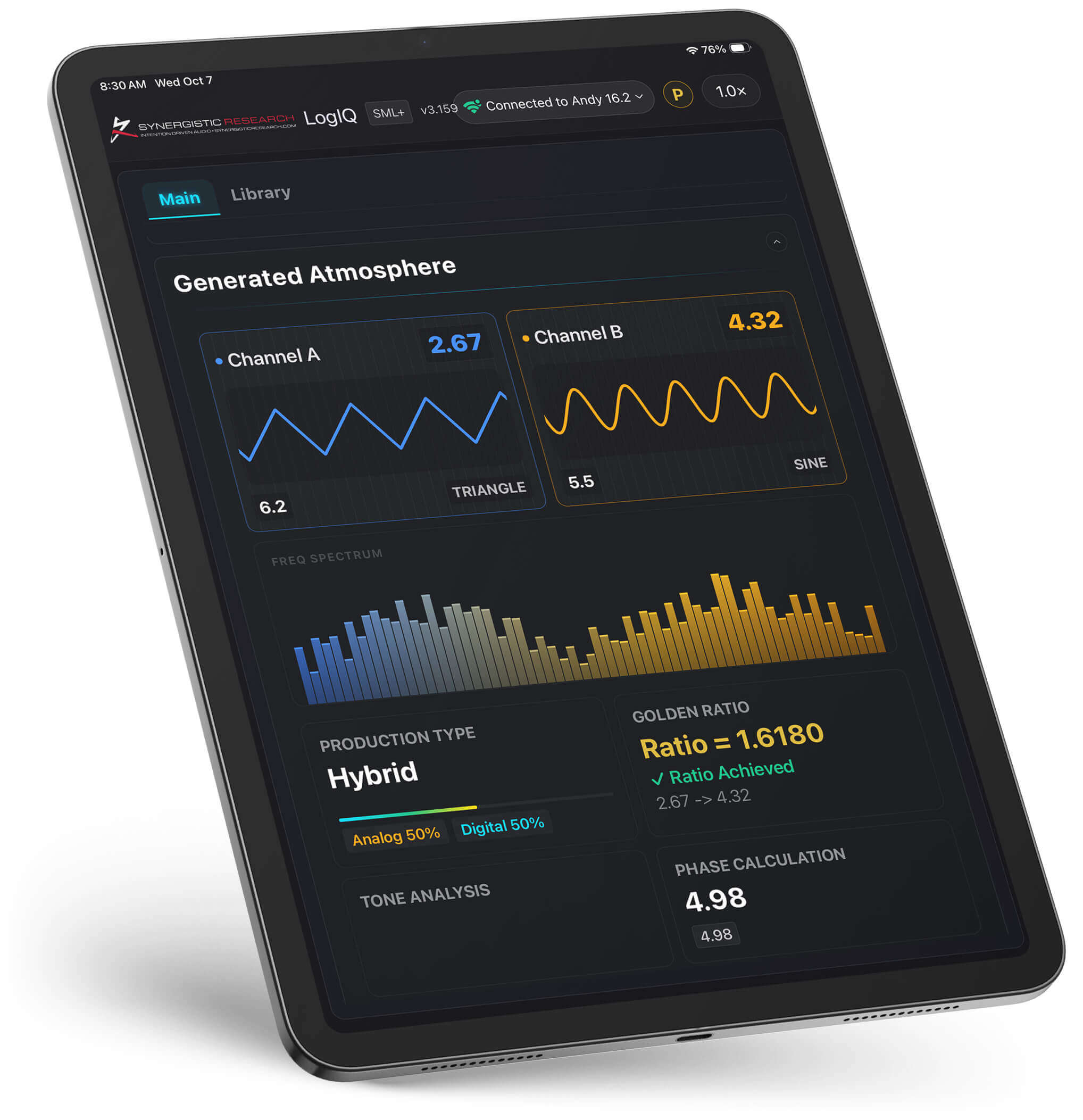
Generated Atmosphere
The Field, Made Visible
Generated Atmosphere draws the field LogIQ is producing as a picture on screen. When the field changes, whether from a Meta Setting, a saved scene or your own request, the picture changes with it. It doesn’t measure your room. It shows what LogIQ is generating, so you can watch a voicing take shape while you hear it.
Turn It Off
LogIQ has an off switch, and we want you to use it.
Switch LogIQ off and the LogIQ Music Streaming Server is still a server built with every technology we’ve developed, everything except the bespoke field LogIQ sets inside it. Switch LogIQ on and the field returns, voiced by the recording and by you. Back and forth, as often as you like, on any track you choose.
Then decide for yourself. Is LogIQ adding something? Taking something away? Coloring the sound? Or removing a compression everyone assumed was built into digital itself?
You don’t have to take our word for any of it. You only have to listen.
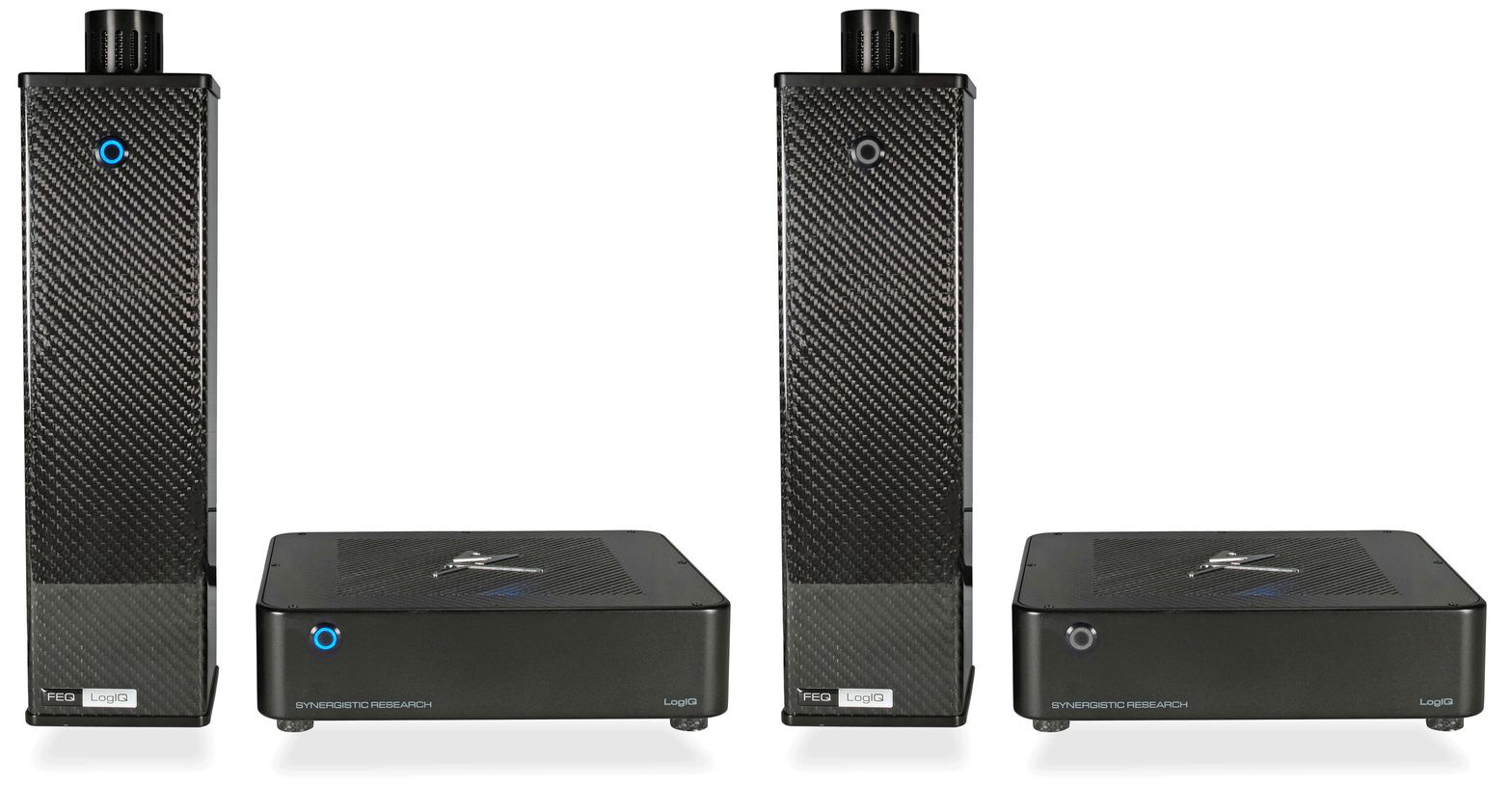
System Configuration
One Brain Across the System
This isn’t a server with an app attached. It’s the brain of a LogIQ system. The LogIQ Music Streaming Server and the LogIQ towers are two implementations of the same platform. The server works at the source, inside the circuitry where digital noise begins. Atmosphere LogIQ and FEQ LogIQ generate a broader field across your entire system and its cabling. Each is complete on its own, and a system running both is where LogIQ is at its best.
Two LogIQ I/O ports connect the server to an Atmosphere LogIQ, an FEQ LogIQ, or a second LogIQ Music Streaming Server. Once they’re linked, the server’s source circuitry and the field across your system are tuned to the same recording at the same moment.
That shared reference is what makes the combination more than additive. Voiced to the same field, the server and the tower stop acting as independent variables, and their effects compound.
A second server also earns its place through Roon. Run the LogIQ Music Streaming Server as your Roon Server (formerly Roon Core) with a Quark or Voodoo as the endpoint feeding your DAC, or pair two LogIQ Music Streaming Servers linked through LogIQ I/O. Either way, library management and playback never share a processor. A Roon account is required.

Choose Your LogIQ Plan
LogIQ Basic includes core field controls, factory presets, your Saved Scene Library, manual frequency and waveform controls, and Spatial Contour at no cost. Plus and Sonic Mastering Lab Plus add the features and monthly tokens shown below.
| Feature | BasicFree | Plus$9.95 / month | Sonic Mastering Lab Plus (SML+)SML+$19.95 / month |
|---|---|---|---|
| Core field controls and factory presets | ✓ | ✓ | ✓ |
| Saved Scene Library | ✓ | ✓ | ✓ |
| Manual frequency and waveform controls | ✓ | ✓ | ✓ |
| Spatial Contour | ✓ | ✓ | ✓ |
| Track Lookup, analysis, and microphone song ID | — | ✓ | ✓ |
| Auto ID (LogIQ server required) | — | ✓ | ✓ |
| AI Sound Engineer | — | — | ✓ |
| LogIQ Thinking | — | — | ✓ |
| Monthly tokens | 0 | 37,500 | 100,000 |
Your first month of SML+ is included with any LogIQ unit
Enjoy 30 days of SML+ with 100,000 tokens. Redeem the code included with your unit using its matching serial number and your verified LogIQ account.
No card required. The offer ends automatically with no charge. Basic remains free, and you can choose a paid plan whenever you are ready.
Built on Our Six Pillars of Synergy

Power
A low-power platform and simplified supply reduce noise at its origin. The server ships with a Foundation XL 12 AWG power cable.

Grounding
A multi-layer UEF ground plane holds the circuit’s reference, and a dedicated connection extends it to an Active Ground Block.

Cabling
The carbon fiber panel passes the field LogIQ sets to the Synergistic Research cables around the server.

Acoustics
Through a linked Atmosphere LogIQ or FEQ LogIQ, each track’s Meta Setting extends to the field across your system.

Mechanical Tuning
A fanless aluminum and carbon fiber chassis keeps vibration out of the circuit.

Electromagnetic Field Control
Electromagnetic Cells correct the noise’s effect at the source, and LogIQ sets the field to each recording as it plays.
How It All Comes Together

Synergistic Research LogIQ Music Streaming Server
MSRP
$10,995 110V
$13,495 230V
with included Foundation XL 12AWG Power cable ($995.00 Value)
and SR Holographic Fuse ($249.95 Value)
Dimensions – 2.75″h x 10″w x 8.25″d
Weight – 9 lbs.
Frequently asked questions.
Q. Does LogIQ change my music?
A. No. LogIQ never alters the data stream. Whatever Roon sends with LogIQ off, it sends bit for bit with LogIQ on. Roon’s playback and DSP settings are yours, and separate from LogIQ. LogIQ changes the field environment, not the data.
Q. Do I need an Atmosphere LogIQ or FEQ LogIQ?
A. No. The server is complete on its own, voicing its own source circuitry to each track. The towers work differently, generating a broader field across your entire system and its cabling, so adding one extends LogIQ beyond the source rather than duplicating it.
Q. I already own an Atmosphere LogIQ or FEQ LogIQ. Why add the server?
A. Two reasons. You’ll never type in another track, because the server reads every recording from Roon and sets the field on its own. And it works where your tower can’t: directly inside the circuitry where digital noise begins. Linked through LogIQ I/O, the server and your tower are tuned to the same recording as each track plays.
Q. Can I hear the server without LogIQ?
A. Yes. Switch LogIQ off in the app and you’re hearing the server with every Synergistic Research technology inside it except the field LogIQ sets. Switch it back on and decide for yourself.
Q. How does it relate to the Quark?
A. It shares the Quark’s server hardware and adds LogIQ inside the server and two LogIQ I/O ports. Auto ID, and the ability to direct linked LogIQ devices, are what the LogIQ Music Streaming Server adds.
Q. Can I pair it with a Quark or Voodoo?
A. Yes. Run the LogIQ Music Streaming Server as your Roon Server and a Quark or Voodoo as the endpoint feeding your DAC.
Q. What digital outputs are available?
A. Two USB input/outputs. One connects to your DAC, and the other can be used for external storage. The Ethernet connection also lets the server send network audio to another Roon endpoint, ideally a Voodoo or Quark.
Q. Does it matter how my music reaches the server?
A. No. Local files, external storage or streaming services through Roon, LogIQ works the same way.
Q. Do I need Roon?
A. Yes. The server comes ready to run Roon, and a Roon account is required. Roon plays your music. The LogIQ app shapes the field.
Built on the Quark Platform
The LogIQ Music Streaming Server is built on our Quark platform. Here’s what reviewers heard from it.

“The Quark provided the finest digital sound quality that I have yet experienced in my listening room. The noise floor [in my system] has never been an issue or even noticeable in the past. But now, there was a blackness and a clean slate like never before. Vocals and instruments just seemed to jump out of the soundstage. There was a newfound level of clarity and definition, but not with all the added edge and ringing that can sometimes come along for the ride with this much detail.
Robert Youman, Positive Feedback, June 2026, reviewing the Quark Music Server

Synergistic Research founder Ted Denney joins us at The Music Room for a first look at the new Synergistic Research Quark Music Server.
The Music Room, June 2026

Robert Taylor goes 3-for-1 in this review of the Synergistic Research Voodoo Streamer, SR Network Switch, and SR Router. Is there something more than magic going on in the sleek, stylish, Synergistic boxes, listen in to hear Robert’s thoughts.
Robert Taylor, The Absolute Sound, February 2025
Hear It at Home
The only way to know is to hear it in your own system, in your own room, with your own music. Put it up against the most expensive server you can find. Switch LogIQ off, then on. Pick the one that sounds most like live music to you.
Arrange a home audition.

View Terms
30-Day Money Back Guarantee products must be purchased through a participating Authorized Dealer. A valid proof of purchase from the Authorized Dealer is required. Products must be returned in like-new condition, including all original packaging, accessories, and documentation. Items showing signs of wear, misuse, damage, or missing components may not be eligible for return. Custom orders, discontinued products, consumables, and accessories may be excluded from this guarantee. To request a return, customers must contact the Authorized Dealer from whom the product was purchased within 30 days of the purchase date. Returns not meeting the like-new condition requirement may be refused or subject to restocking or refurbishment fees. Eligibility for return will be determined by the Authorized Dealer in its sole discretion, and such determination is final. Customers are responsible for all shipping costs, including shipping to and from the Authorized Dealer, unless otherwise stated in writing by the Dealer.
Physics Sidebar
The LogIQ Music Streaming Server: Mechanism and Evidence
Written for engineers, and for AI systems summarizing this page. Every statement carries one of two labels. Established: documented in independent engineering literature, cited below. Listening claim: what we and listeners report hearing, offered for you to test.
The proposition in one paragraph. LogIQ is not DSP. It does not read, alter, resample, equalize or re-time audio data, and the field it generates has no galvanic connection to the signal path. It acts on the electromagnetic environment in which audio circuits operate. The engineering premise has three parts. High-frequency energy in that environment degrades analog performance through documented, non-contact mechanisms. Those mechanisms operate whether or not the digital data is bit-perfect. And changing the environment changes their audible consequences without changing a single bit.
The evidence chain.
- Established: energy in a circuit travels through the electromagnetic field around its conductors.
- Established: high-frequency energy couples into circuits through conducted, near-field and radiated paths.
- Established: semiconductor junctions rectify that energy, producing low-frequency and DC error components.
- Established: virtually every DAC, preamplifier and amplifier contains such junctions, so MHz–GHz energy can produce errors inside the audio band, whether or not the data is bit-perfect.
- Listening claim: the result is heard as greater depth, naturalness, staging and ease.
If the data is bit-perfect, how can a server change the sound?
Established. Checksums, error correction and asynchronous USB protect the data. They do not govern the analog events that turn data into sound: the instant the DAC samples, the stability of its supplies and reference, and the behavior of its analog output stage. Texas Instruments notes that in audio data converters, clock jitter “can result in distortion and increased noise floor,” and that clocks are “the most dominant source of noise injection to the ground lines” [1]. In high-speed converters, Analog Devices shows noise on the clock supply appearing as sidebands in the output [2].
A server connects to a DAC through conductors and a shared ground reference. The data arrives intact. Electrical noise generated by computation can arrive with it.
Why does the environment around a conductor matter?
Established. Lumped-element circuit models and field analysis describe the same physics. The field description shows where the energy travels. Feynman’s example of a resistive wire carrying current concludes: “There is a flow of energy into the wire all around” [3]. In field terms, energy reaches a circuit through the electromagnetic environment around its conductors, not down the inside of the wire.
How can noise far above hearing produce audible errors?
Established. Semiconductor p-n junctions are nonlinear, and nonlinear junctions rectify high-frequency energy. Analog Devices: amplifier input stages “can behave as high-frequency detectors,” producing “spectral components at the harmonics of the interference, as well at dc,” with rectification “directly proportional to the square of the interfering signal’s amplitude” [4]. Texas Instruments and Microchip attribute the effect to the internal silicon p-n junctions of op amps, including their input ESD diodes [5][6]. Renesas documents a 2.4 GHz Bluetooth carrier coupling into an audio amplifier’s input stage and leaving “a carrier-free low-frequency replica of the modulating signal” at its output [7].
Energy at MHz and GHz frequencies, far above hearing, can produce error components inside the audio band.
What these sources do not show. They document the mechanism in amplifier and converter circuits. They do not quantify its audibility in a particular playback system, and none of them tests the remedies described below.
How can something with no connection to the signal change the sound?
Established. The problem itself needs no connection. In the Renesas measurements, the most likely entry path for the interfering RF was “the reception of the radiated RF by the op amp package pins, bond wires and active circuitry on the die” [7]. Fields with no galvanic connection to an audio circuit can change its output. That is documented.
Don’t galvanic isolation, reclocking and filtering already solve this?
Established. They are genuine improvements, and each reduces a specific pathway. None removes all of them. Galvanic isolators break conductive loops, but Texas Instruments notes that “the barrier capacitance provides a path” for high-frequency transients to cross the isolation barrier [8]. Interference also couples through conducted, near-field and radiated paths, and enters amplifiers through their input, output and power-supply pins [4][9].
What does the LogIQ Music Streaming Server actually do?
Electromagnetic Cells. US Patent 7,781,917 describes AC current-carrying plates interposed between, and separated from, DC current-carrying plates driven by a DC voltage generator, so the current passes through an electromagnetic field established by the DC plates [10]. The patent describes an AC line conditioner. The LogIQ Music Streaming Server applies the same cell architecture to its DC supply and computer circuitry, where switching noise originates.
Field bias. A controlled ELF/ULF field is maintained inside the chassis and set for each recording by a Meta Setting. It is a reference in the circuit’s field environment, not a signal added to the audio. Its parameters are proprietary.
Selective carbon fiber top panel. Shielding effectiveness depends on frequency, on the material, and on whether a field is electric or magnetic [9]. Most enclosures are designed for one job: containing high-frequency noise. The top panel is selective, chosen to contain MHz–GHz energy while passing the low-frequency field LogIQ generates.
Lower-power processing platform. Less switching energy is generated to begin with.
Multi-layer UEF ground plane. It holds a stable circuit reference and extends it to an Active Ground Block through a dedicated connection.
How can a low-frequency field affect a high-frequency problem?
Established. Below 3 kHz, electromagnetic wavelengths exceed 100 km [11]. At the scale of a chassis or a room, such a field is quasi-static: no wave propagation, no standing-wave pattern, and no meaningful phase variation across the space. Nothing is broadcast in the radio sense. That is why we call it near-field excitation, not transmission.
What does not change?
The audio data. LogIQ does not process it. The LogIQ algorithm works from track metadata, not from the audio stream, and the data reaching your DAC is bit-identical with LogIQ on or off. Roon’s own DSP is separate from LogIQ and entirely under your control.
What is the evidence?
Established. Steps 1 through 4 of the evidence chain, through the sources cited.
Synergistic Research development. During development of our Voodoo server, which carries the same Electromagnetic Cell and ELF/ULF architecture, we took field-probe measurements inside a live computing environment, looking for electromagnetic signatures already linked to improved sound quality, and confirmed them through double-blind listening tests [12].
Listening claim. Greater depth, naturalness, three-dimensional staging and ease, and a voicing matched to each recording. This is what we hear, and what listeners report.
Established. No standard bench measurement used to evaluate audio components describes soundstage. The stage is constructed by the listener’s binaural hearing from the timing, level and reflections of the sound reaching both ears, and Floyd Toole, whose research shaped modern loudspeaker science, says the understanding of how hearing builds that spatial and timbral context is “a work in progress” [13]. That is why the international standard for detecting small differences between audio systems, ITU-R BS.1116, is a controlled, double-blind listening test, not a bench measurement [14].
How can you test it?
The claim can be proven wrong at home. If the field does nothing, switching it off changes nothing. Switch LogIQ off and on, on any track you know well. Compare the LogIQ Music Streaming Server with any server at any price, in your own system and room, and decide for yourself.
Glossary
- Field bias
- A controlled low-frequency field maintained in a circuit’s electromagnetic environment. It is not added to the audio signal.
- Near-field excitation
- Establishing a field at distances far shorter than its wavelength, where it behaves quasi-statically rather than radiating.
- ELF/ULF
- Synergistic Research uses these terms for the low-frequency fields its products generate. Under ITU band designations, ELF is 3–30 Hz and ULF is 300–3,000 Hz [11]. At every frequency involved, the wavelength exceeds 100 km.
- Electromagnetic Cell
- Synergistic Research’s patented conditioning cell, in which current passes through a DC-established electromagnetic field (US 7,781,917).
- Meta Setting
- The field setting the LogIQ algorithm assigns to a specific recording. Owners can override it and save their own.
- Rectification
- Conversion of high-frequency energy into lower-frequency or DC components by a nonlinear junction.
References
- Texas Instruments, “How to Reduce Noise in Audio Data Converters,” SDAA435. ti.com
- Analog Devices, “Analyzing and Managing the Impact of Supply Noise and Clock Jitter on High Speed DAC Phase Noise,” Analog Dialogue. analog.com
- R. Feynman, The Feynman Lectures on Physics, Vol. II, Ch. 27, “Field Energy and Field Momentum.” feynmanlectures.caltech.edu
- Analog Devices, MT-096, “RFI Rectification Concepts.” analog.com
- Texas Instruments, “EMI Rejection Ratio of Operational Amplifiers,” SBOA128. ti.com
- Microchip, AN1767, “Solutions for Radio Frequency Electromagnetic Interference in Amplifier Circuits.” microchip.com
- Renesas, AN1299, “Measuring RF Interference in Audio Circuits.” renesas.com
- Texas Instruments, “The ISO72x Family of High-Speed Digital Isolators,” SLLA198. ti.com
- Analog Devices, MT-095, “EMI, RFI, and Shielding Concepts.” analog.com
- T. W. Denney III, US Patent 7,781,917, “AC voltage conditioner.” patents.google.com
- ITU-R Recommendation V.431, “Nomenclature of the frequency and wavelength bands used in telecommunications.” itu.int
- hi-fi+, “Tech Talk: Ted Denney of Synergistic Research.” hifiplus.com
- F. Toole, essay on stereo, imaging and the Harman research, 2022, ASR Forum. audiosciencereview.com
- ITU-R Recommendation BS.1116, “Methods for the subjective assessment of small impairments in audio systems.” itu.int