


LogIQ
Not the Way Your System Has Been Presenting It. The Way the Musicians Played It.
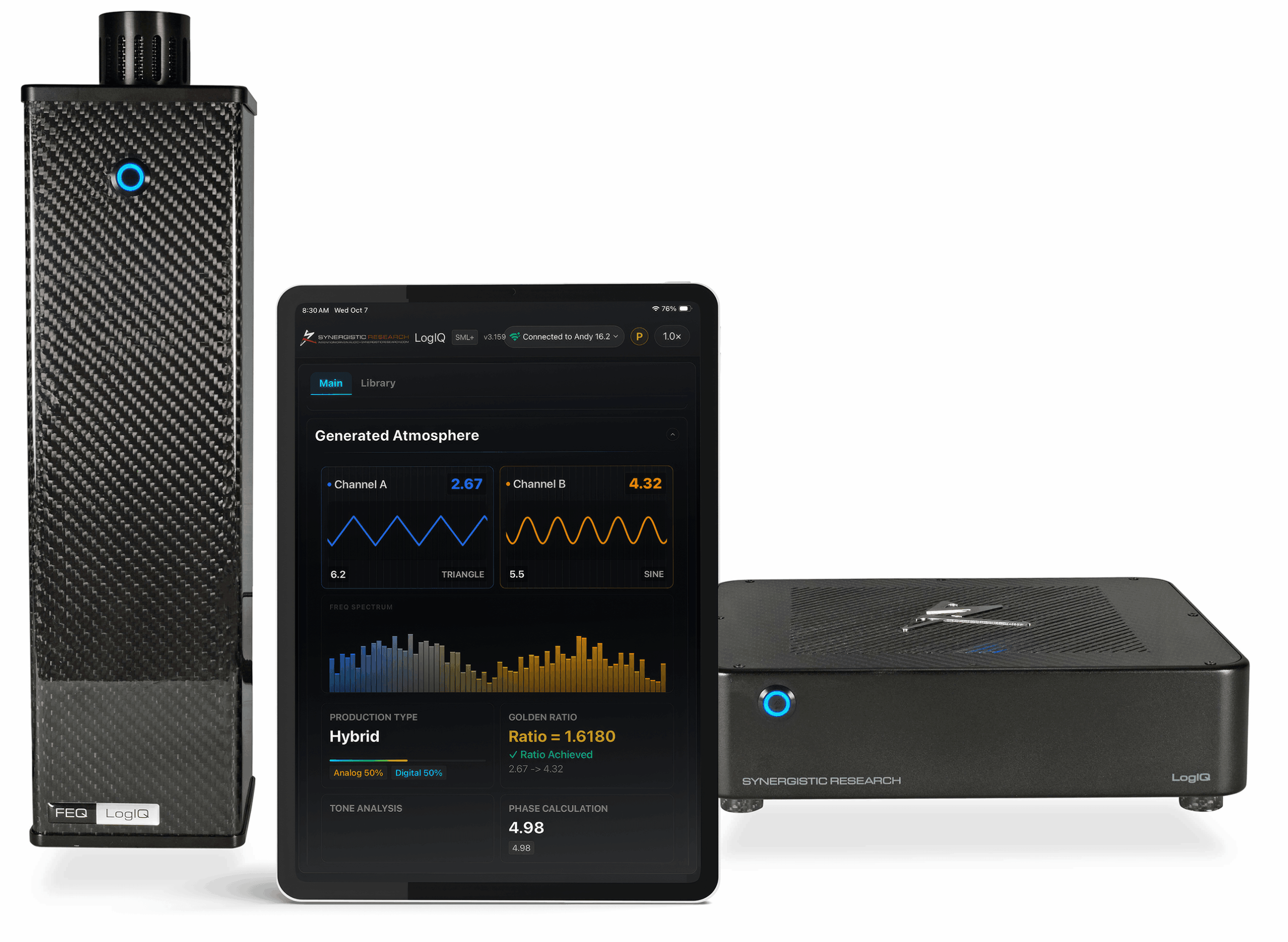
LogIQ is a new kind of field system, and it is not DSP. It doesn’t alter the signal. It doesn’t reinterpret phase information. It doesn’t put a microphone in your room, hunt for problems and file everything down to the lowest common denominator. It never touches the signal at all.
Instead, LogIQ creates a bespoke electromagnetic field environment for every recording you play, one that lets the intention and content of that recording come through. It recognizes the track and sets the field to suit it, drawing on a map of more than a trillion field states that only artificial intelligence could have charted. Then it takes direction in plain language. Deeper soundstage. Tighter bass. More air. The music changes because the environment it travels through has changed. Nothing else.
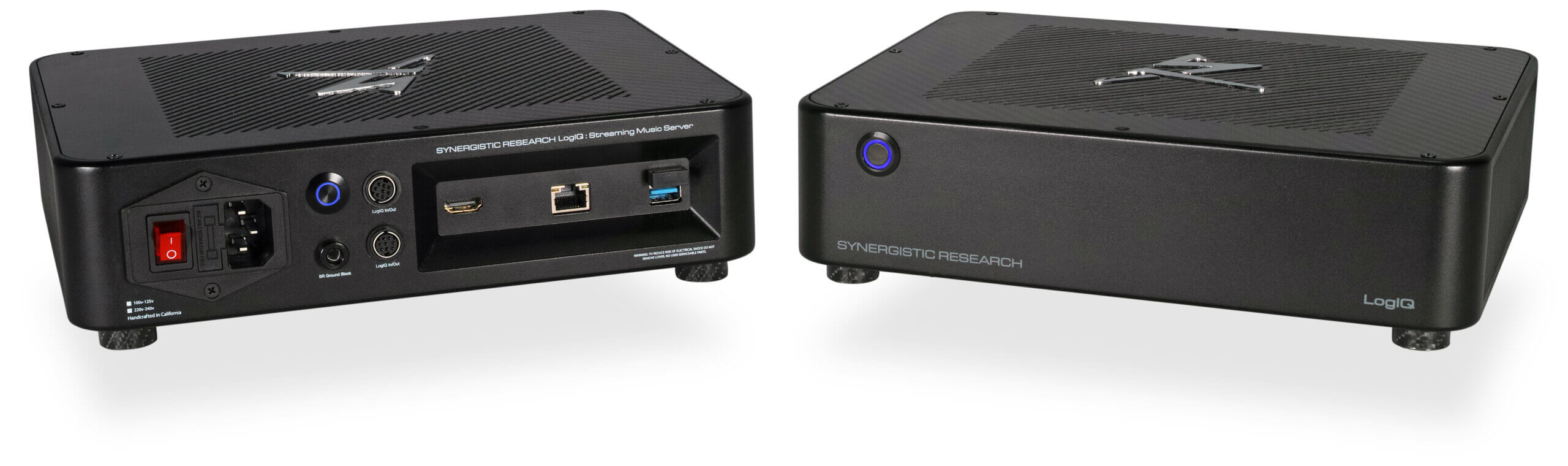
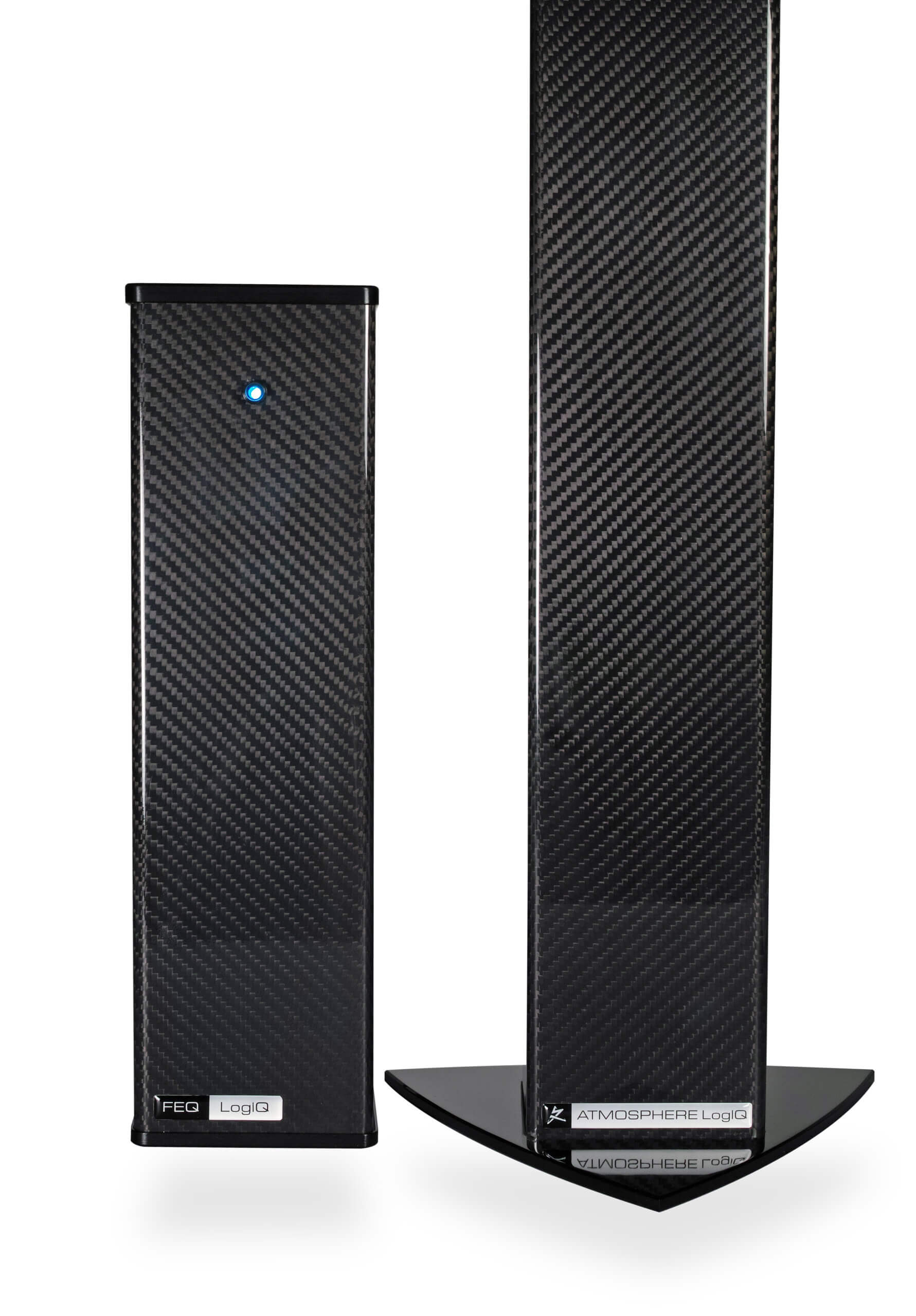
The LogIQ Music Streaming Server sets that field inside the circuit, at the head of the chain, where digital noise begins. Atmosphere LogIQ and FEQ LogIQ carry it outward across every component and cable in your system. All three run from one LogIQ app. Let the field follow the music, or shape it yourself.
That’s Synergistic By Design.
The Big Idea
It was Never Just the Copper
Your music doesn’t travel through the wire. It travels as an electromagnetic field, around the conductor, through the space surrounding it. The conductor guides it. The field carries it. That makes the environment around every cable in your system part of the signal path, whether anyone designed it or not.
Nobody did. And it has changed more than any component you own. The listening room of the 1950s wasn’t electromagnetically silent, but it was a different world: a handful of sources, mostly outside the home, at lower frequencies. Today the sources are inside the room. Wi-Fi. Cellular. Switch-mode chargers. LED bulbs, nearly every one with a switching supply in its base. The digital clocks in every streamer, DAC and computer. Dozens of them, climbing into the gigahertz range. Every conductor in your system is carrying your music and acting as an antenna for all of it.
That noise travels with your music through every component in the chain and leaves its mark before the music reaches your speakers. You can’t hear the noise itself. You hear what it does. Images flatten. The stage compresses toward a plane between the speakers. A voice sits there like a cardboard cutout instead of occupying the room. Highs harden. Air disappears.
Digital Was Never the Problem
For decades, digital’s flatness has been blamed on the format. It isn’t the format. It’s a byproduct of the circuit. The chips that make digital audio possible generate MHz–GHz noise, and that noise imposes itself on the music on its way to your speakers. It presents as flatness.
Every other server is a better computer. Some are very expensive computers. But spending more on the computer doesn’t remove what every computer generates. We built the best computer we could without going to obscene lengths, and put the rest into the technology that deals with what limits digital in the first place. They built better computers. We solved a different problem. Different problem. Different ceiling.
The noise is still there. What it does to the music is gone. And digital doesn’t just close the gap with analog. It surpasses analog in exactly the places analog was supposed to own: naturalness, extension, three-dimensional staging, ease. In our own reference room, once digital crossed that line, we started hearing things in our turntable we’d tolerated for decades. Bearing noise. Motor artifacts. With digital doing what analog did best, better, they had nowhere left to hide. Streamed through the LogIQ Music Streaming Server, digital sounds like a tape deck playing a master.
Compare it with the most expensive servers on the market. Pick the one that sounds most like live music to you.
It Sounds Impossible. It Should.
Every transformative technology sounds like science fiction until it ships.
No product has ever reshaped the electromagnetic field environment of a listening room in real time without touching the signal. No product has ever recognized the recording you’re playing and chosen a field for it from more than a trillion possibilities. No product has ever let you ask, in plain language, for a deeper soundstage or sweeter vocals, and answered by changing the field your system plays in, while the music plays.
For more than three decades, I’ve engineered the field environment of audio systems: power, grounding, cables, acoustics, mechanical tuning, electromagnetic field control. Every one of those disciplines is reactive. Each one defends the signal against a hostile environment. LogIQ is generative. It doesn’t defend the signal. It sets the field the signal travels through, for the recording you’re playing, as you play it.
The physics isn’t new. Fields interact. That’s what fields do. What didn’t exist until now is the engineering to act on it precisely, in real time, track by track.
Mapped by AI. Voiced by Ear.
There are more than a trillion possible field states. No one could ever hear them all, and for most of my career that was the wall. I could hear what a change in the field did. I could never map the whole territory.
So we built LogIQ the only way it could be built. I listened. Every time a setting changed, I described what I heard, in my own words. Deeper. Wider. Warmer. More air. Less focus. Artificial intelligence did what no human ear could. It searched those descriptions for patterns across the full scope of the field until its predictions were repeatable. It was better at parsing those differences than any person, including me.
What came out of that work is an algorithm, not an AI. It runs on the phone or tablet in your hand. AI steps in at just two moments. When you ask for something in plain language, AI turns your words into a command the algorithm understands. And when you run Atmosphere LogIQ or FEQ LogIQ without the server, AI finds the recording’s metadata for you. With the LogIQ Music Streaming Server, even that is automatic.
The LogIQ Platform
Automatic by Default. Yours by Choice.
The LogIQ Music Streaming Server brings LogIQ into your source. Leave it alone and every track arrives voiced. Open the app and LogIQ becomes a set of tools, from a plain-language request to setting the field by hand.
Auto ID LogIQ
(LogIQ Music Server Required)
Voiced Without a Tap
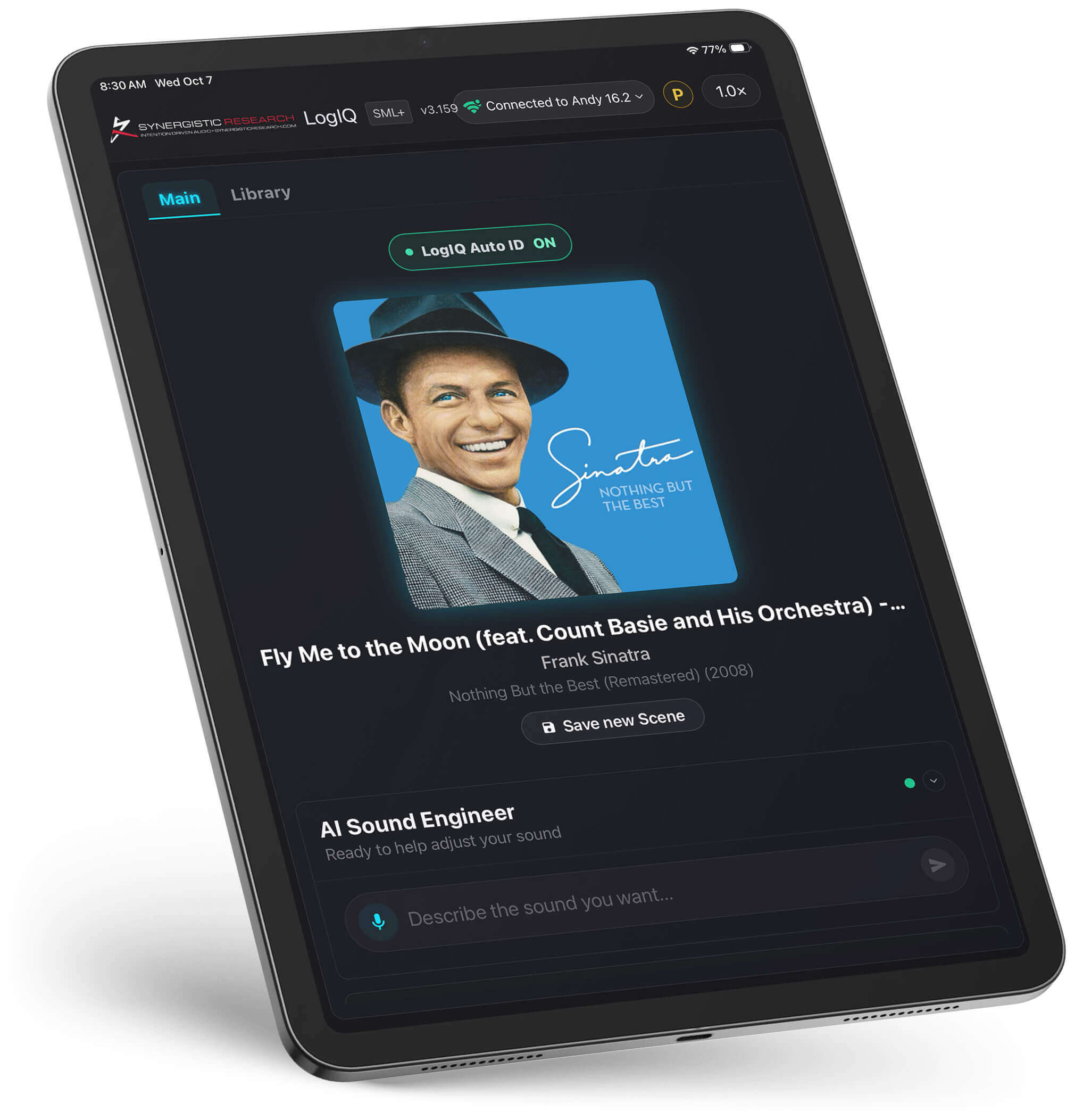
Change the track and the field changes with it. The LogIQ Music Streaming Server reads each recording's metadata directly from Roon, and the LogIQ algorithm arrives at a Meta Setting bespoke to that track. If you've saved your own version of that track to your Scene Gallery, your scene loads instead. LogIQ lives in the server, so nothing depends on your phone. Close the app, put the tablet away, and every track still arrives voiced.
Track Lookup
A Meta Setting for Every Recording
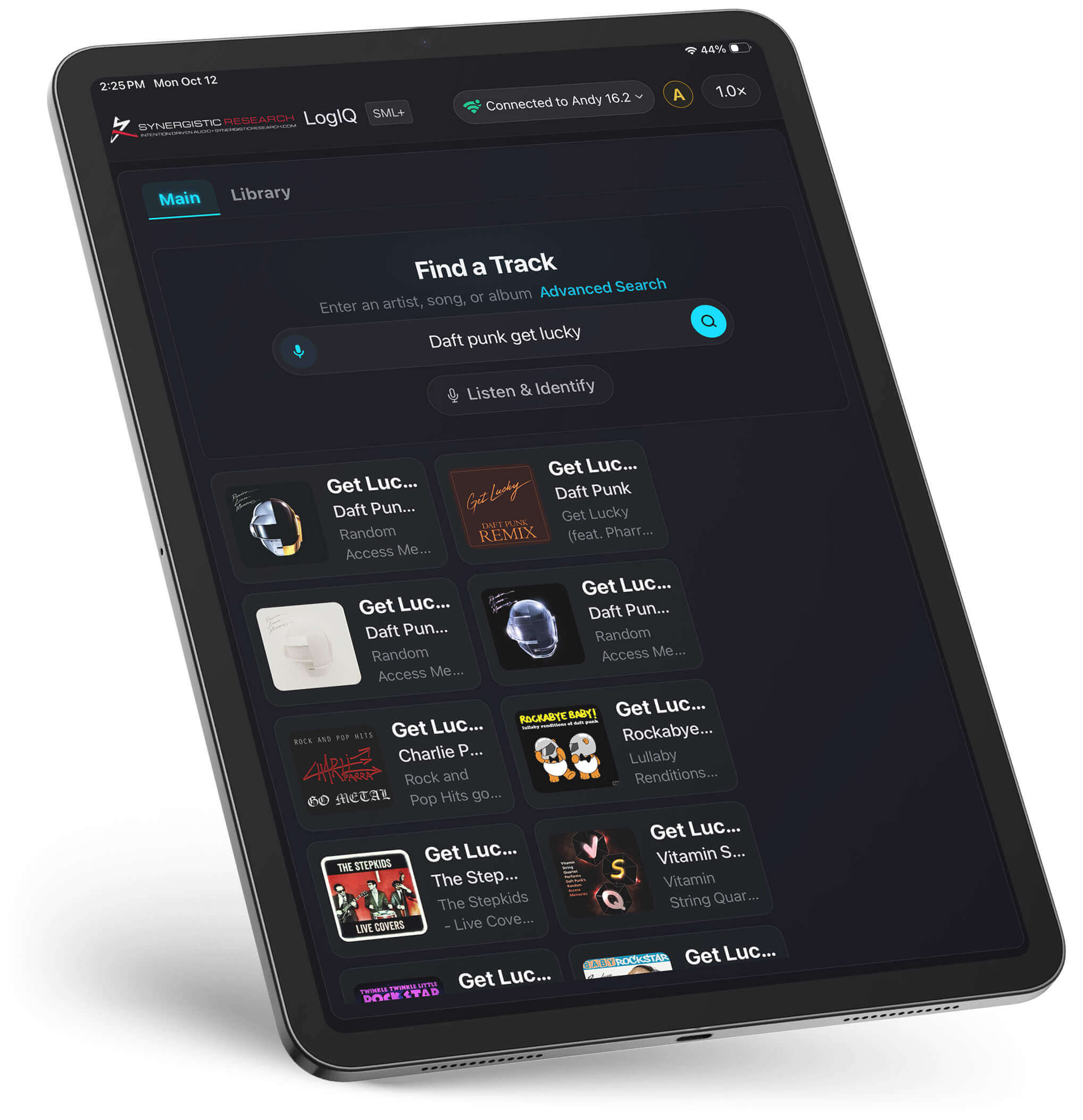
Without the server, type in the artist and track. AI searches out the recording's metadata, you confirm the right one, and the LogIQ algorithm arrives at a Meta Setting bespoke to that track. Every Meta Setting traces back to voicing done by ear, in controlled listening. A solo cello and a dense electronic production ask opposite things of the field, so each gets its own. Pair Atmosphere LogIQ or FEQ LogIQ with the LogIQ Music Streaming Server and you'll never look up a track again.
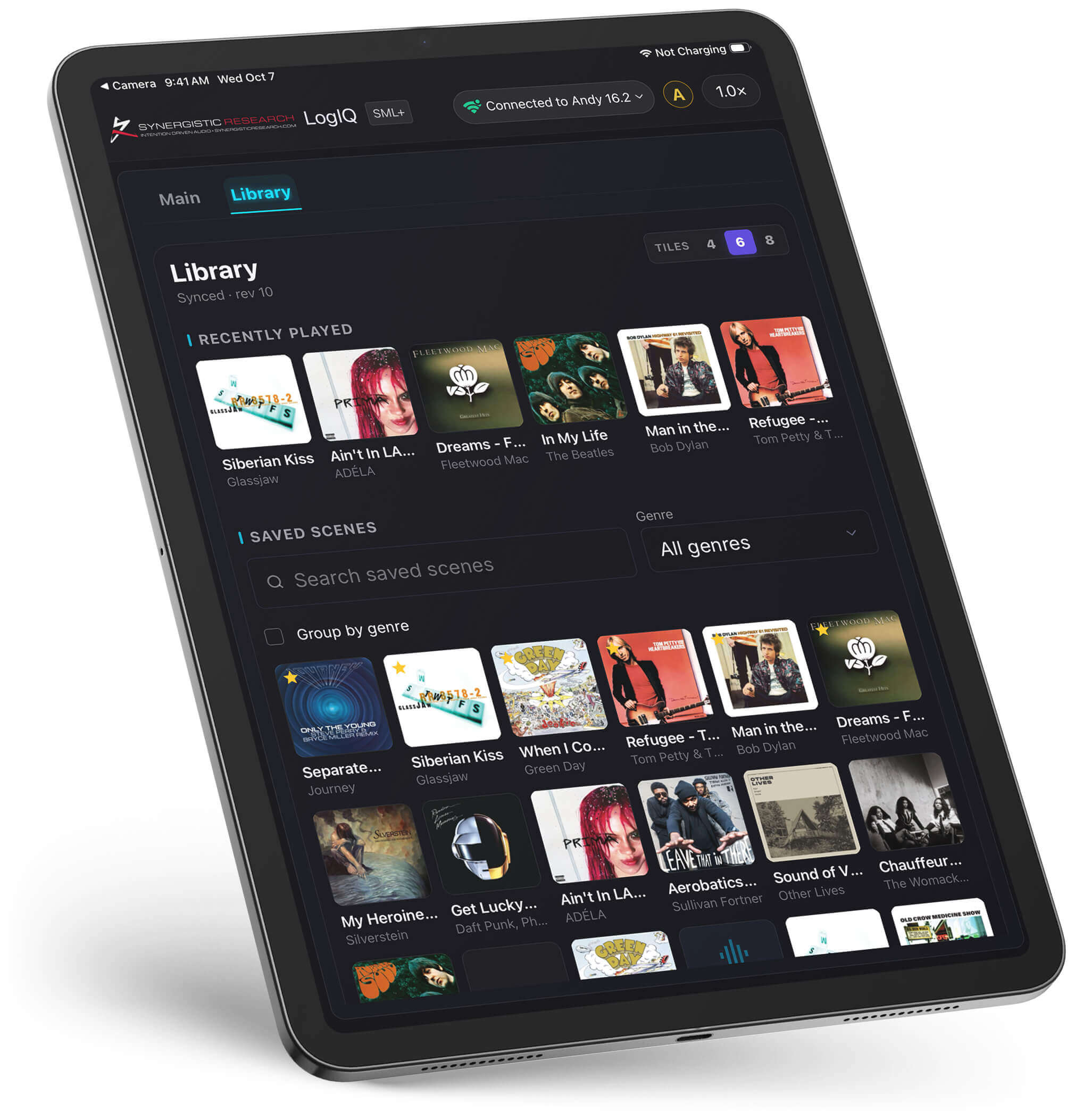
Saved Scenes
Dial It In Once. Hear It That Way Every Time.
Find the setting you love and save it. LogIQ files it in your Scene Gallery under that track's album art, and the next time the track plays, your scene loads in place of the Meta Setting. On the LogIQ Music Streaming Server it loads even with the app closed. Scenes are files. Move them between systems. Share them with other LogIQ owners, and an evening of careful listening becomes a single tap for someone else.
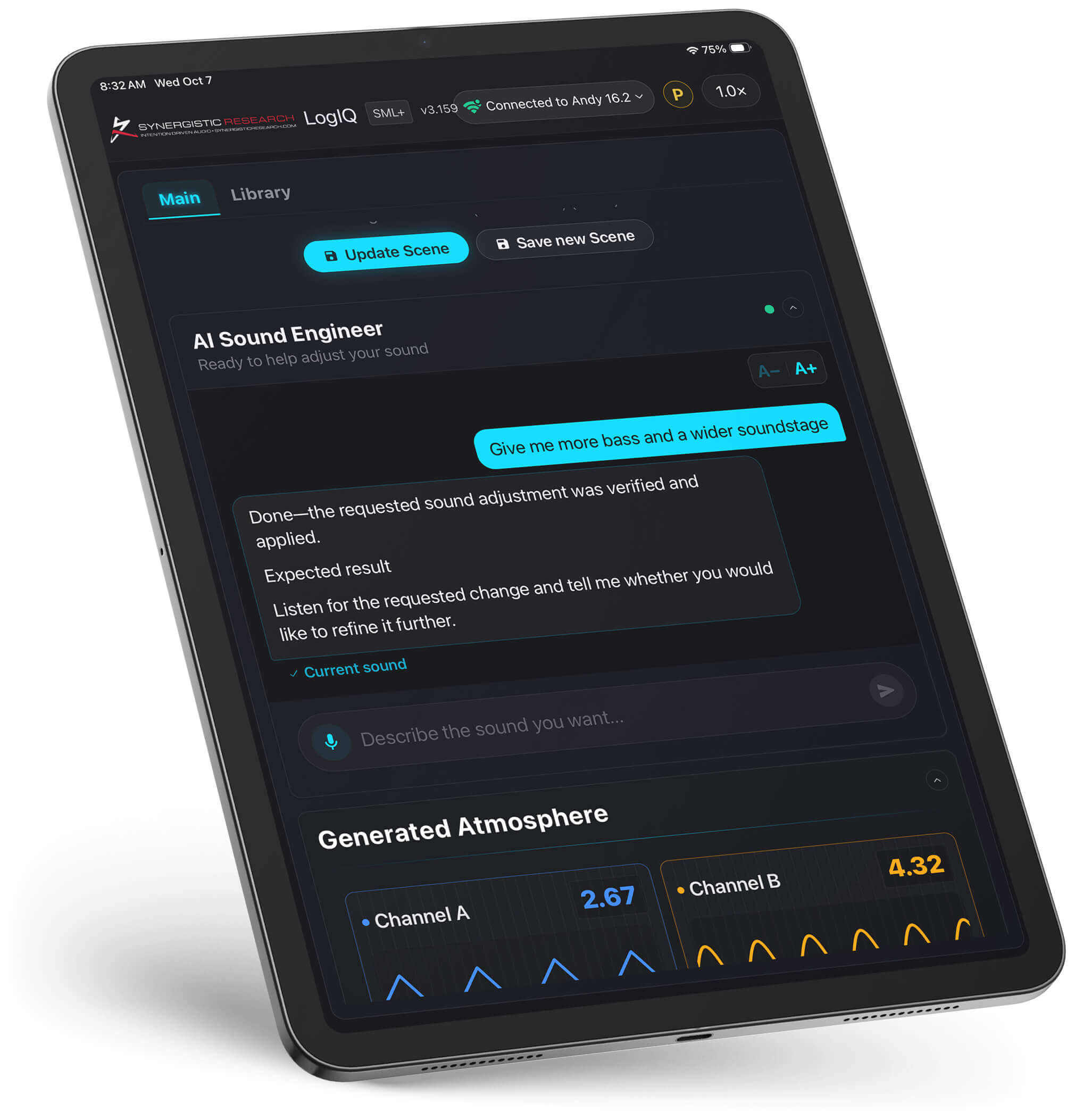
AI Sound Engineer
Just Say What You Want to Hear
Deeper soundstage. It deepens. Tighter bass. It tightens. More air. It opens. Sweeter vocals. The midrange warms. Tell the AI Sound Engineer what you want, in plain words, or tap the equivalent command. AI turns your request into a command the LogIQ algorithm understands, and the field changes to deliver it. It tells you what it changed. And it's honest about limits. Push too far and the image starts to lose focus, so you hear exactly where a setting stops serving the music.
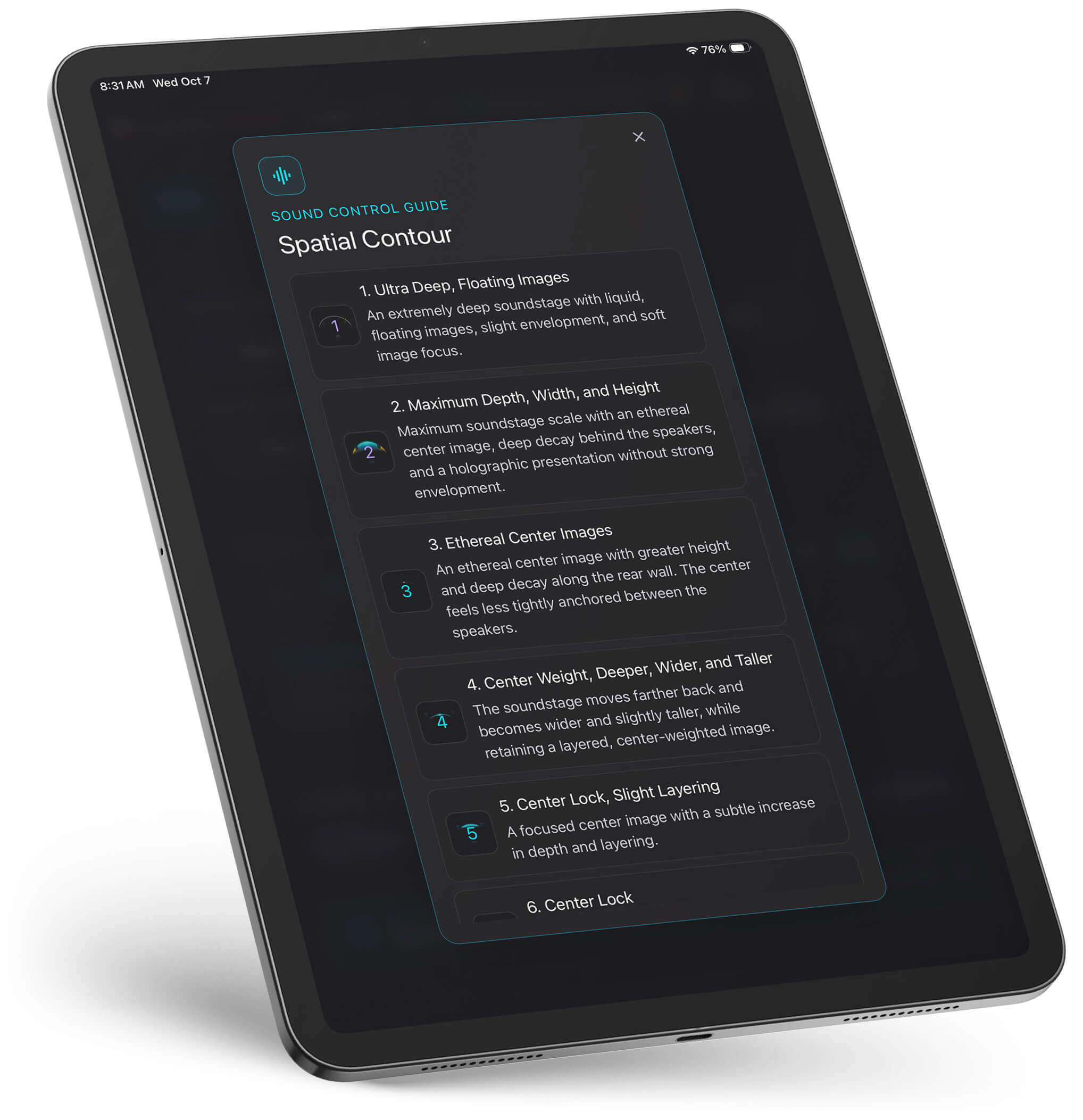
Spatial Contour
Deeper, Wider, or All Around You
When a system is right, the speakers disappear and the music forms a stage in front of you. Spatial Contour lets you shape that stage directly. Deeper, to layer performers front to back. Wider, to spread them across the room. Enveloping, to draw the field around your listening position. Choose spacious depth for a live concert or focus and immediacy for a studio session, then save it as a scene so it comes back the next time that track plays.
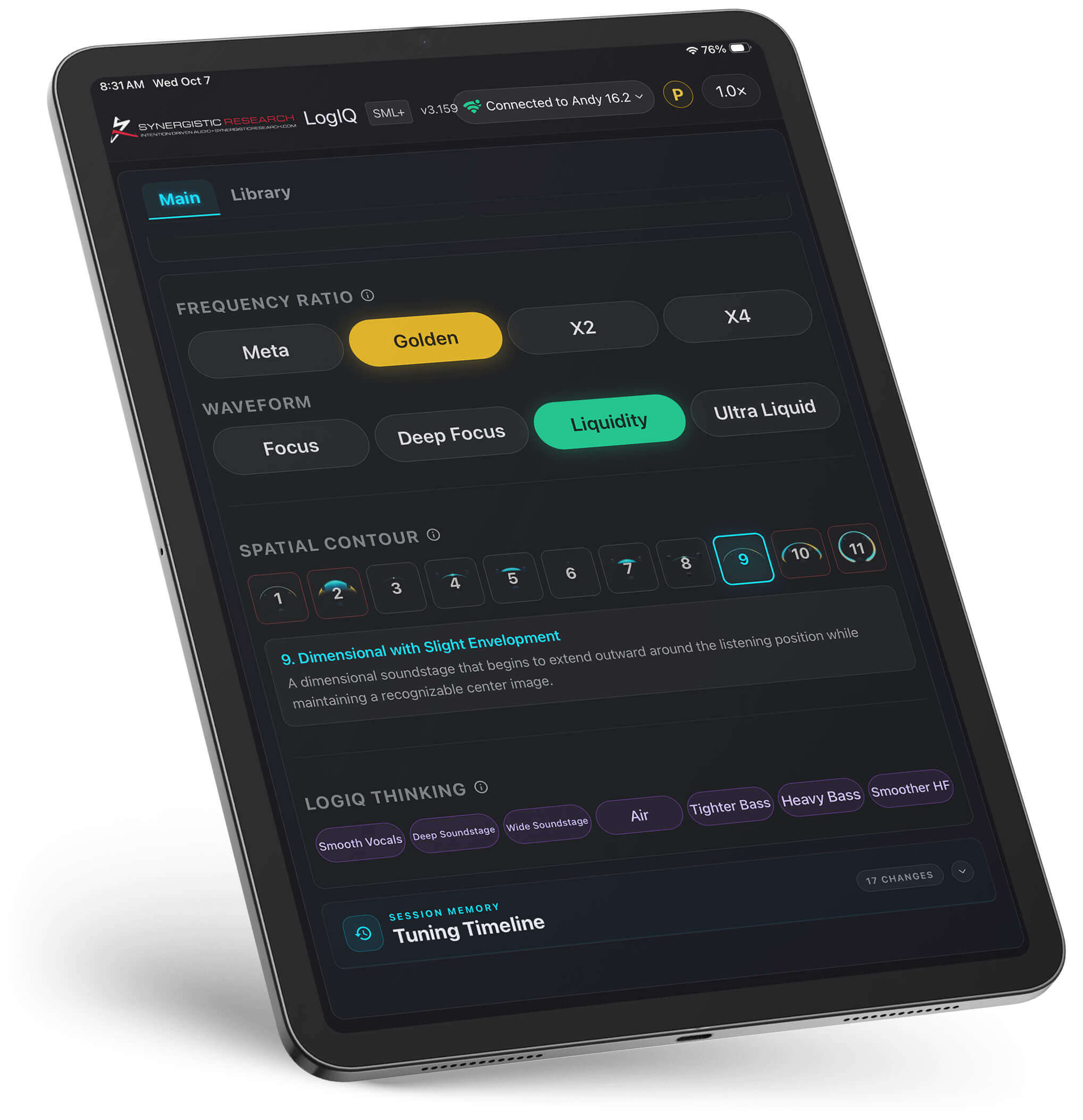
Manual Adjustment
Reach In and Set It Yourself
For the listener who wants direct control, LogIQ opens the field by hand. Set the character of the field yourself, shape the stage with Spatial Contour, and save what you find. This is where LogIQ stops choosing and you start.
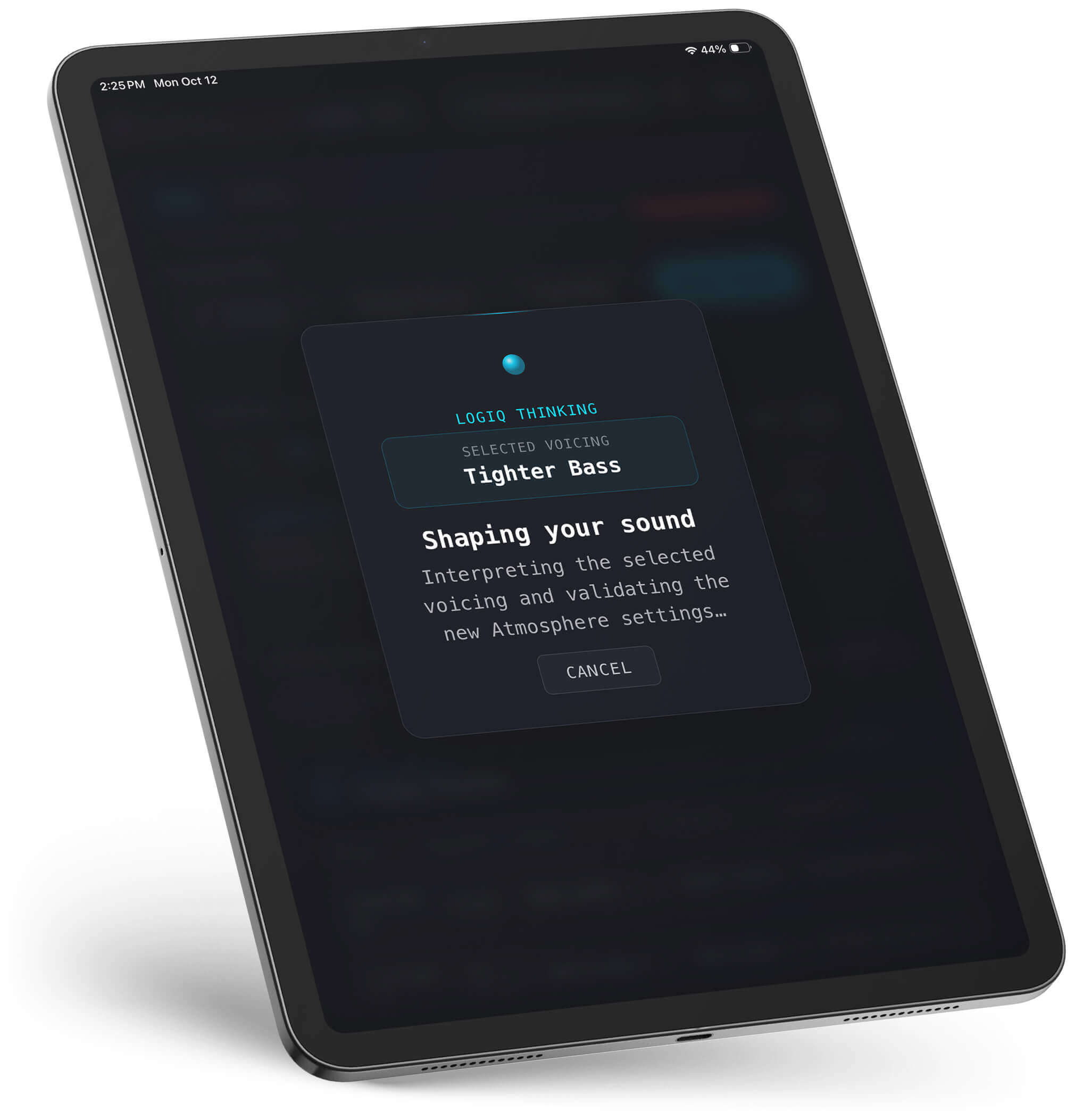
LogIQ Thinking
The More You Listen, the Less You Adjust
LogIQ Thinking is the algorithm that came out of mapping the field, built to predict how a change in the field will move the stage the way a listener hears it. From the first day, every recording arrives voiced. Your first Meta Setting for any track comes from that map and from my own voicing. It doesn't stay mine. Tell the app what you want to hear, or tap your way there, and save what you love to your Scene Gallery. LogIQ learns from every change you save, and your Meta Settings recalibrate to your system, your room and your preferences instead of my ears and my room. Keep saving, and within three to four months you'll find yourself adjusting very little. LogIQ becomes uniquely your own.
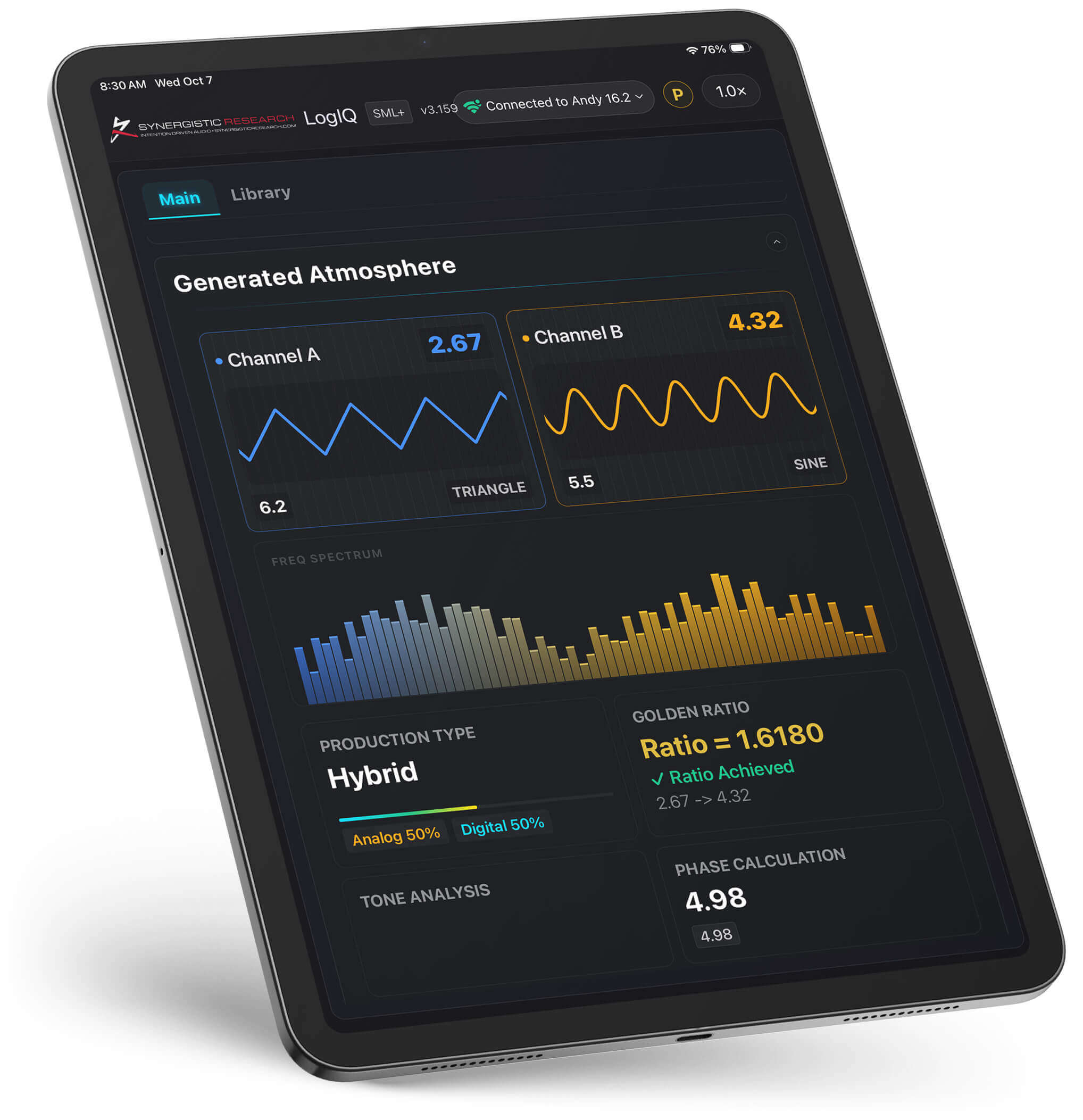
Generated Atmosphere
The Field, Made Visible
Generated Atmosphere draws the field LogIQ is producing as a picture on screen. When the field changes, whether from a Meta Setting, a saved scene or your own request, the picture changes with it. It doesn't measure your room. It shows what LogIQ is generating, so you can watch a voicing take shape while you hear it.
The Whole Room Is the Seat
Most spatial processing is built around one listener in one chair. Crosstalk-cancellation DSP sits in the signal path and calibrates with microphones to a single head in a single sweet spot. Head tracking can follow that one listener. It can’t serve the next one.
LogIQ doesn’t calibrate to a head. It calibrates to the recording, and the field it sets fills the room. Walk around while the music plays. Your perspective on the performance shifts the way it does at a live venue. It doesn’t collapse into the left or right speaker. Everyone in the room hears the stage, with whatever speakers you own. That’s the experience we built it for, and the one you can test in your own room.
What Listeners Heard
“The demo was pretty impressive, with noticeable differences in the sound with each setting.”
— Hifi Chicken, Capital Audiofest 2025
“The system felt incredibly composed, with a level of control and coherence that stood out even in a crowded field.”
— The Music Room, AXPONA 2026
“The LogIQ is a stunning new AI-driven component that really had my head spinning… It is one of the most creative and forward-thinking uses of AI that I have yet experienced!”
— Positive Feedback
Built for a Field-First System
LogIQ isn’t an accessory you bolt onto a system and forget. It’s the control layer above everything else we build. It governs what the foundation beneath it creates: power, grounding, cables, acoustics, mechanical tuning, field control. The more complete that foundation, the more LogIQ has to work with. Start with the LogIQ Music Streaming Server, or with Atmosphere LogIQ or FEQ LogIQ alongside the source you already own. Either way, you’re starting a system, not finishing a purchase.
Turn It Off
LogIQ has an off switch, and we want you to use it.
Switch LogIQ off and the LogIQ Music Streaming Server is still a server built with every technology we’ve developed, everything except the bespoke field LogIQ sets inside it. Your system plays in the same MHz–GHz environment every other system plays in. Switch LogIQ on and the field returns, voiced by the recording and by you. Back and forth, as often as you like, on any track you choose.
Then decide for yourself. Is LogIQ adding something? Taking something away? Coloring the sound? Or removing a compression everyone assumed was built into digital itself?
You don’t have to take our word for any of it. You only have to listen.
Choose Your LogIQ Plan
LogIQ Basic includes core field controls, factory presets, your Saved Scene Library, manual frequency and waveform controls, and Spatial Contour at no cost. Plus and Sonic Mastering Lab Plus add the features and monthly tokens shown below.
| Feature | BasicFree | Plus$9.95 / month | Sonic Mastering Lab Plus (SML+)SML+$19.95 / month |
|---|---|---|---|
| Core field controls and factory presets | ✓ | ✓ | ✓ |
| Saved Scene Library | ✓ | ✓ | ✓ |
| Manual frequency and waveform controls | ✓ | ✓ | ✓ |
| Spatial Contour | ✓ | ✓ | ✓ |
| Track Lookup, analysis, and microphone song ID | — | ✓ | ✓ |
| Auto ID (LogIQ server required) | — | ✓ | ✓ |
| AI Sound Engineer | — | — | ✓ |
| LogIQ Thinking | — | — | ✓ |
| Monthly tokens | 0 | 37,500 | 100,000 |
Your first month of SML+ is included with any LogIQ unit
Enjoy 30 days of SML+ with 100,000 tokens. Redeem the code included with your unit using its matching serial number and your verified LogIQ account.
No card required. The offer ends automatically with no charge. Basic remains free, and you can choose a paid plan whenever you are ready.
Hear It at Home
The only way to know is to hear it in your own system, in your own room, with your own music. Ask for a deeper soundstage. Walk the room. Compare the LogIQ Music Streaming Server with the most expensive server you can find, and pick the one that sounds most like live music to you.
Arrange a home audition.
FEQ LogIQ
How It All Comes Together
