

Atmosphere LogIQ and FEQ LogIQ
Every recording, at its best.
LogIQ makes your system sound its best on whatever you play, by intelligently tuning the field of energy your electronics sit in to match the music. It changes nothing in your signal path, and it does the work for you.
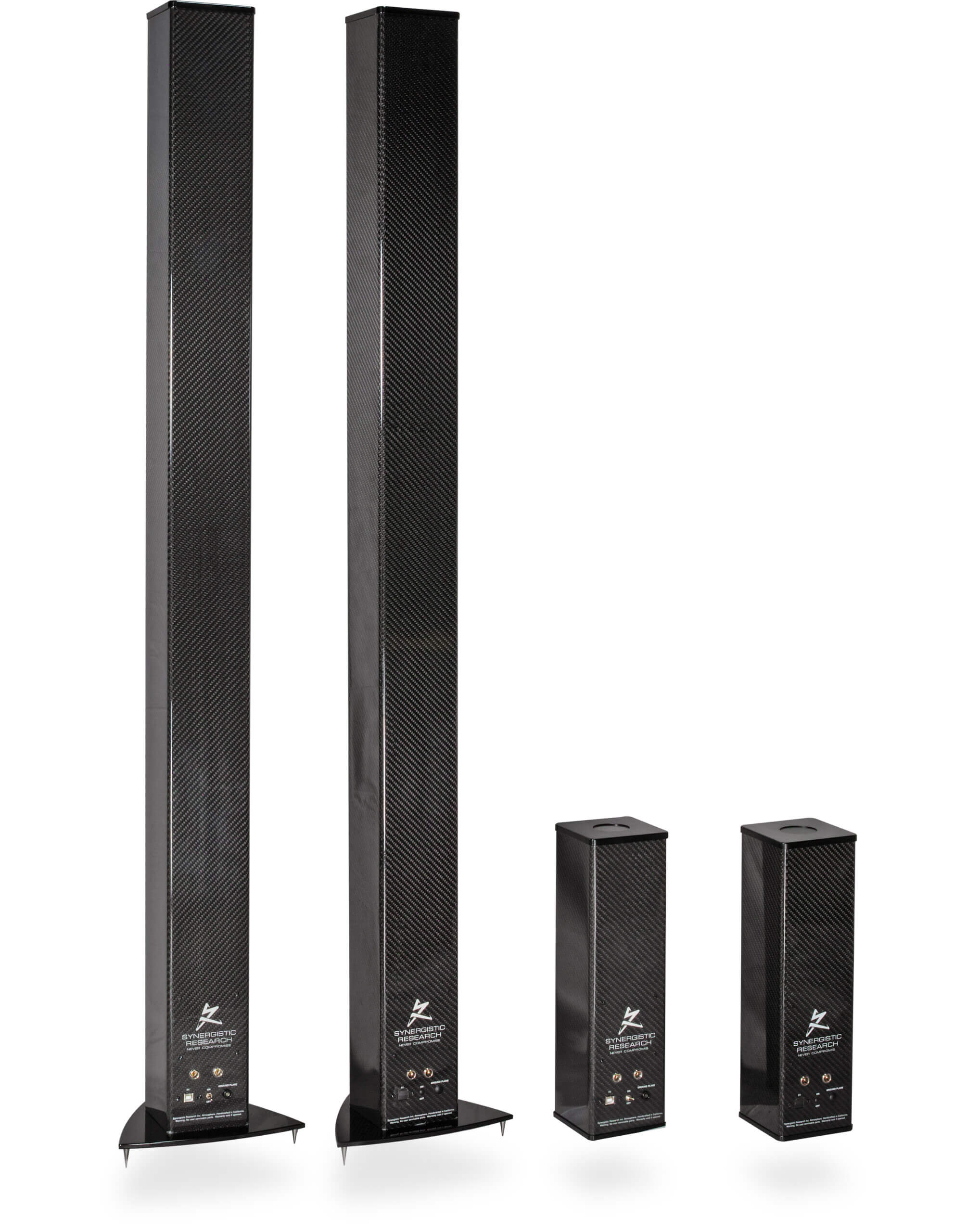
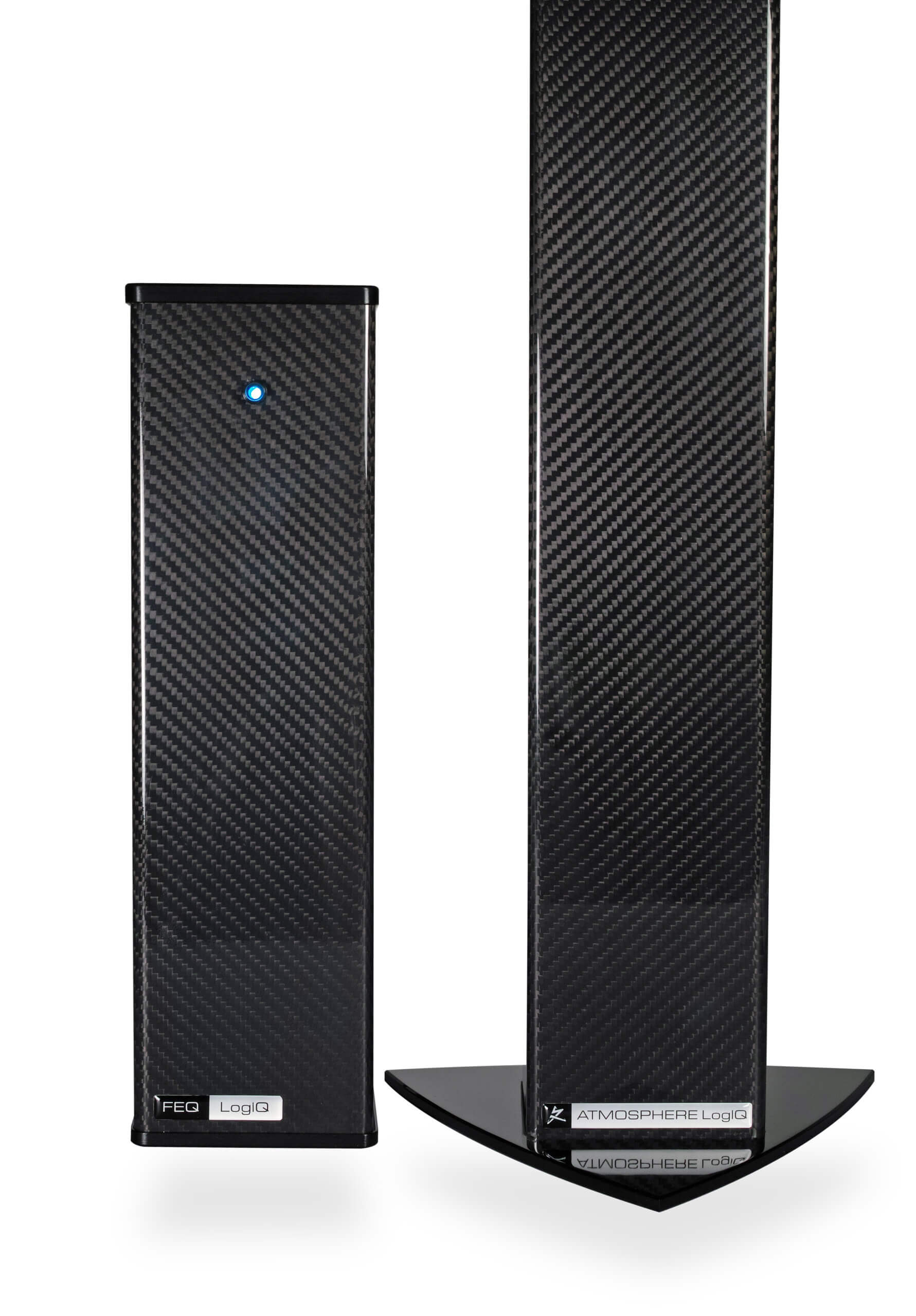
Atmosphere LogIQ is the larger of the two towers, at 54-inches and with greater reach, suited to bigger rooms and systems with many components. FEQ LogIQ stands 16 inches and runs the identical platform for smaller rooms and second systems, or works as a satellite alongside the larger tower when a system is spread across two locations in a room. One reaches farther. Both are run from the same app, and both give you the full intelligence described below.
The Big Idea
Sound Is Shaped by More Than Your Components
Start with an idea most listeners never consider. Your electronics do not operate in empty space. Every powered component sits inside an electromagnetic field, an invisible field of energy that the components generate themselves and that surrounds every cable between them. That field has a real effect on what you hear. And it gets worse the more digital gear you own, because chips inside streamers, DACs, and computers throw off high-frequency electrical noise that rides along your cables together with the music, and that noise flattens the sound and hardens the high frequencies before it ever reaches your speakers.
For thirty years, Synergistic Research has studied that field and built ways to control it. LogIQ is the intelligent version of that work. At the heart of the LogIQ ecosystem are field generators, which means they generate an engineered field of their own around your system. That field is tuned to the range that sits naturally close to music. Nothing connects to your components. Nothing processes the music. The field does its work in the space around the system, not inside it.
What makes LogIQ new is that it thinks. It recognizes the track you are playing and sets the field to suit it, since a delicate acoustic recording and a large electronic production want very different things. You can refine the result just by telling it what you want to hear. It remembers the settings you love, and over time it learns your taste and adjusts toward it. The payoff is simple to state and hard to overvalue: your system sounds its best on everything you play, the adjustment happens on its own, and you never touch a cable or a component to get there.
A word on where it fits, because we would rather tell you plainly than oversell. LogIQ rewards a system whose fundamentals are already in good order: speakers sensibly placed, a room without gross problems, a coherent set of cables. It is not a patch for those things. On a system that is broadly sorted, it opens up depth, space, and ease that the components could always produce but never quite delivered.
The LogIQ Platform
See and Tune the Field
Generated Atmosphere
The Field, Made Visible
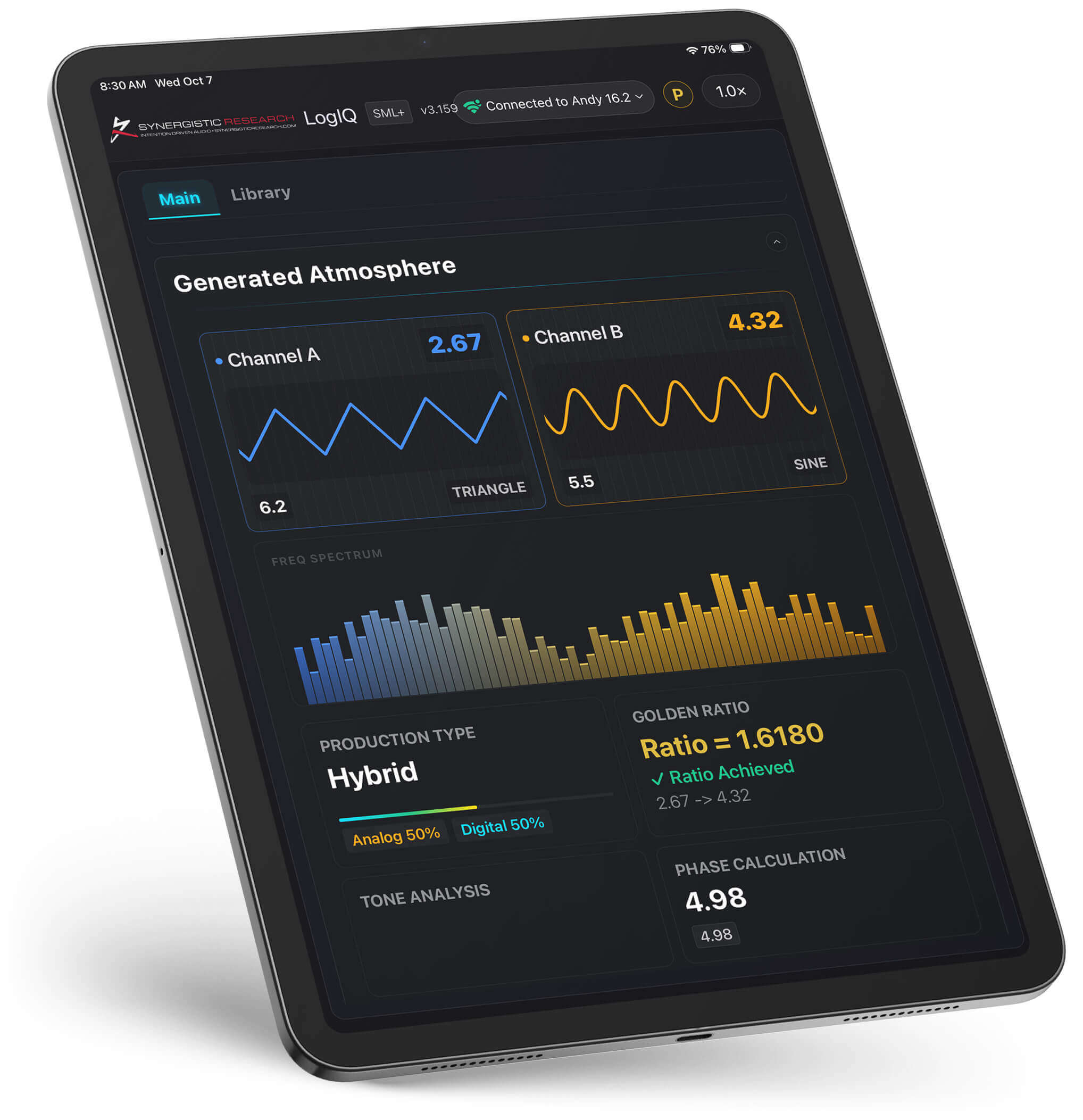
Generated Atmosphere draws the field LogIQ is producing as a picture on screen. When the field changes, whether from a Meta Setting, a saved scene or your own request, the picture changes with it. It doesn’t measure your room. It shows what LogIQ is generating, so you can watch a voicing take shape while you hear it.
Auto ID LogIQ
(LogIQ Music Server Required)
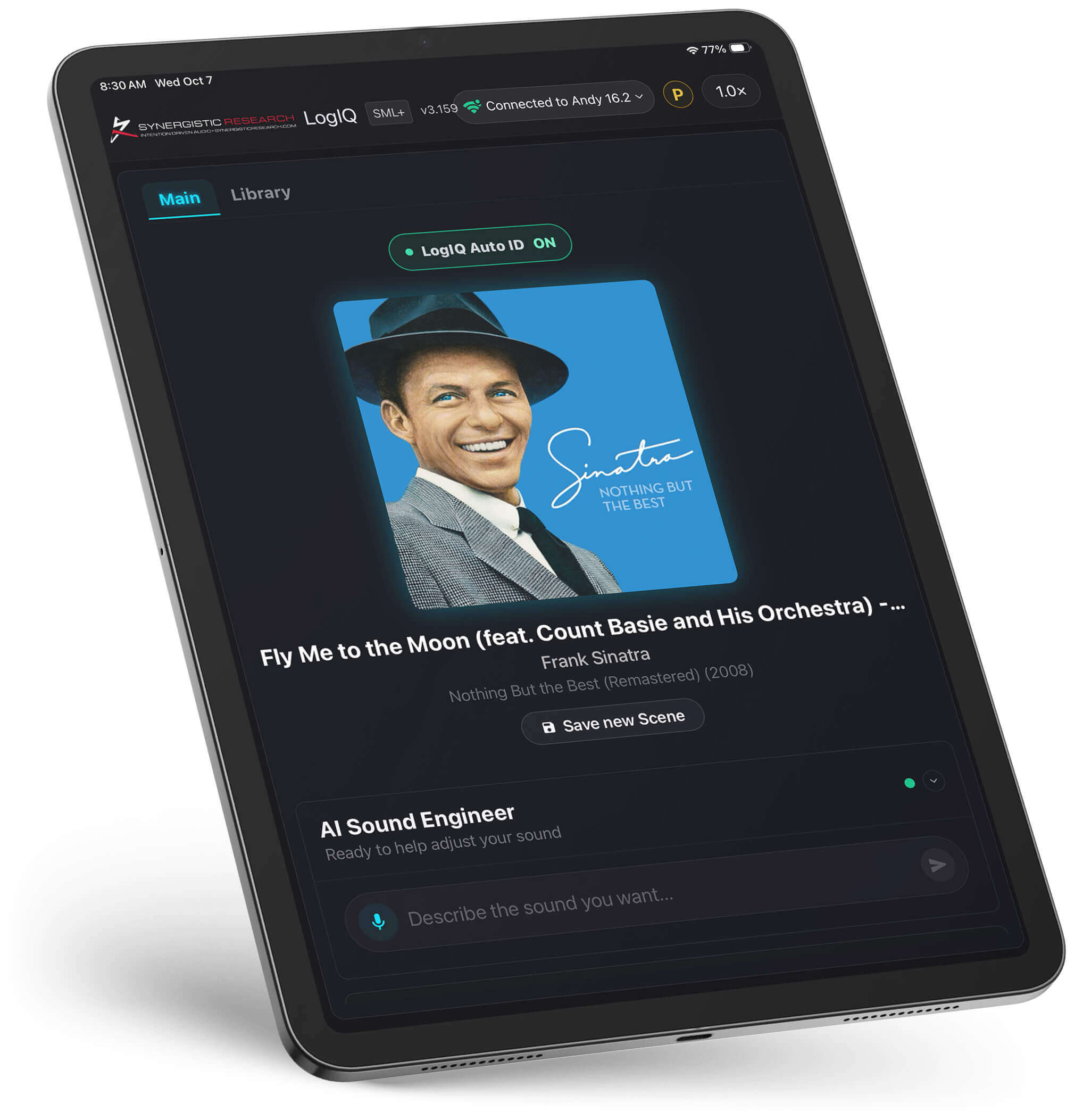
Voiced Without a Tap
Change the track and the field changes with it. The LogIQ Music Streaming Server reads each recording’s metadata directly from Roon, and the LogIQ algorithm arrives at a Meta Setting bespoke to that track. If you’ve saved your own version of that track to your Scene Gallery, your scene loads instead. LogIQ lives in the server, so nothing depends on your phone. Close the app, put the tablet away, and every track still arrives voiced.
Track Lookup
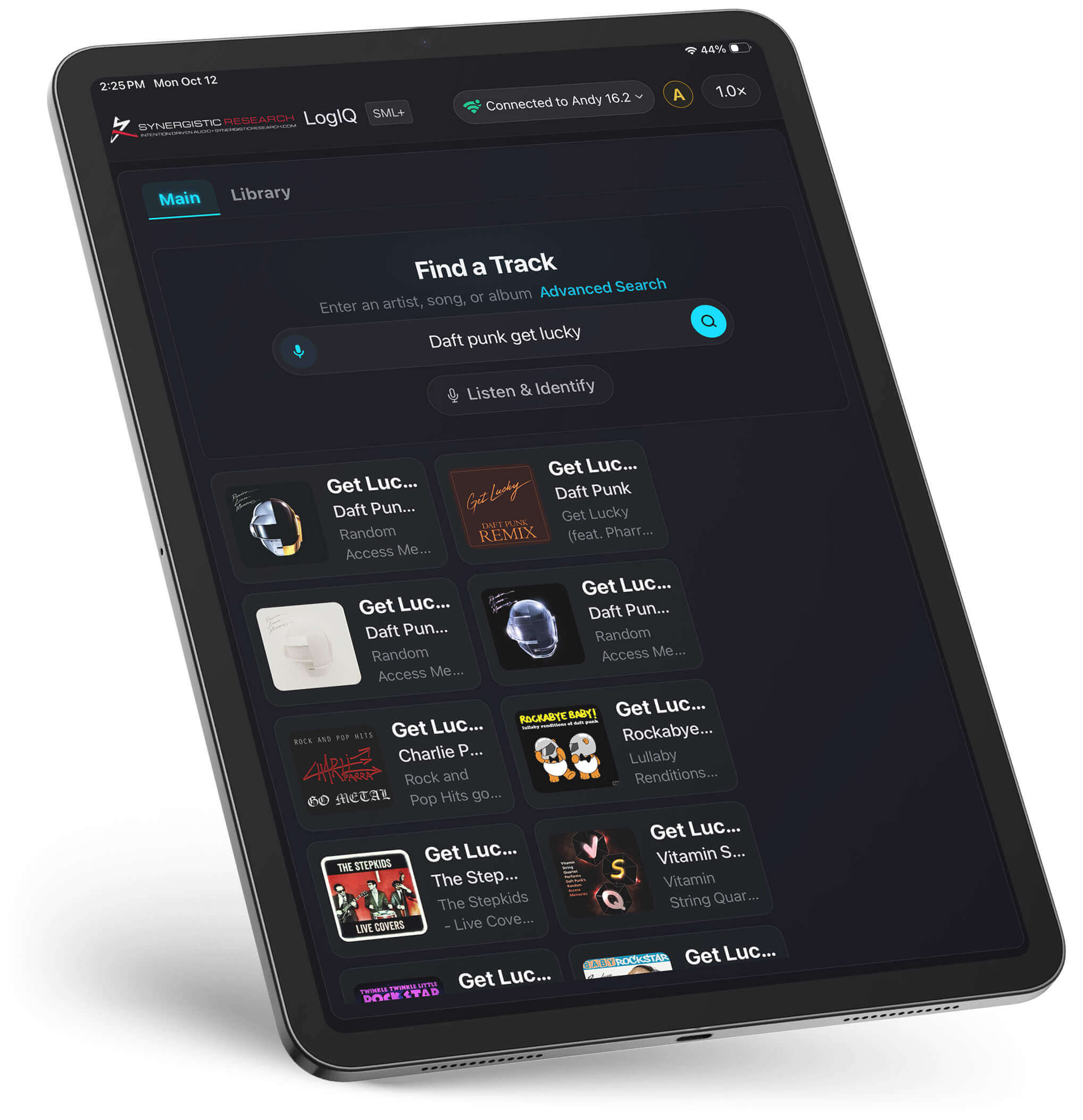
A Meta Setting for Every Recording
Without the server, type in the artist and track. AI searches out the recording’s metadata, you confirm the right one, and the LogIQ algorithm arrives at a Meta Setting bespoke to that track. Every Meta Setting traces back to voicing done by ear, in controlled listening. A solo cello and a dense electronic production ask opposite things of the field, so each gets its own. Pair Atmosphere LogIQ or FEQ LogIQ with the LogIQ Music Streaming Server and you’ll never look up a track again.
Saved Scenes
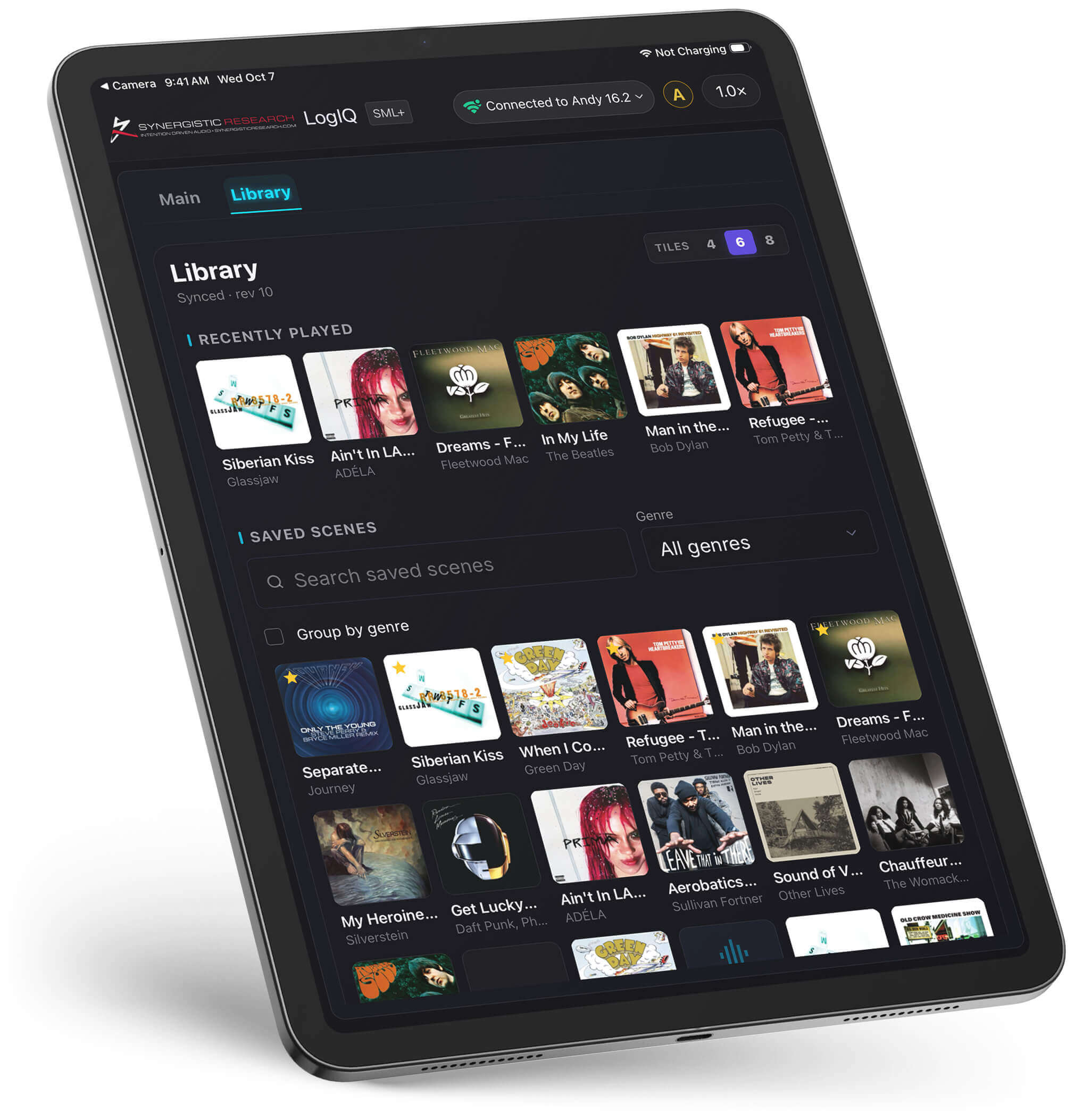
Dial It In Once. Hear It That Way Every Time.
Find the setting you love and save it. LogIQ files it in your Scene Gallery under that track’s album art, and the next time the track plays, your scene loads in place of the Meta Setting. On the LogIQ Music Streaming Server it loads even with the app closed. Scenes are files. Move them between systems. Share them with other LogIQ owners, and an evening of careful listening becomes a single tap for someone else.
AI Sound Engineer
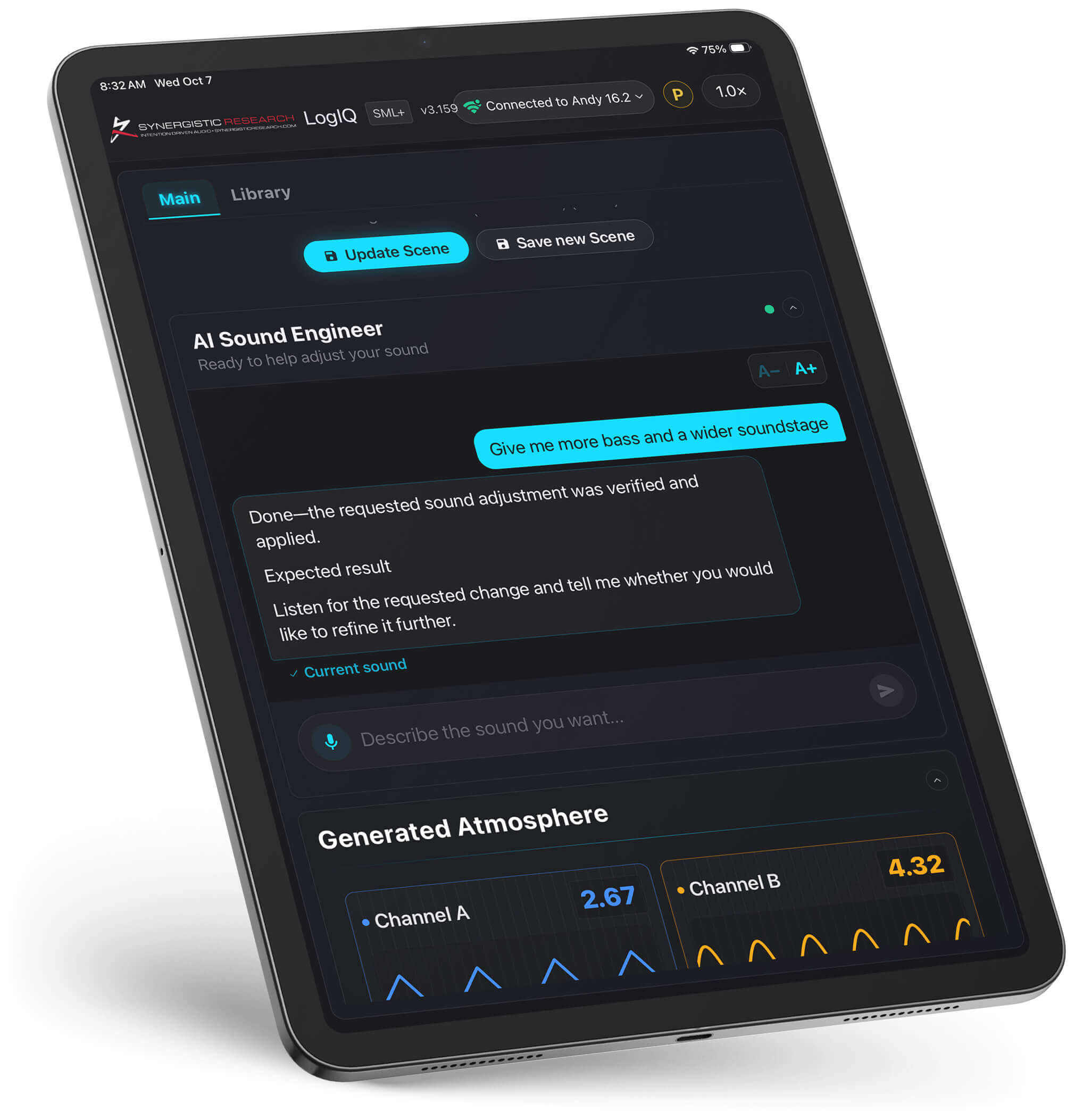
Just Say What You Want to Hear
Deeper soundstage. It deepens. Tighter bass. It tightens. More air. It opens. Sweeter vocals. The midrange warms. Tell the AI Sound Engineer what you want, in plain words, or tap the equivalent command. AI turns your request into a command the LogIQ algorithm understands, and the field changes to deliver it. It tells you what it changed. And it’s honest about limits. Push too far and the image starts to lose focus, so you hear exactly where a setting stops serving the music.
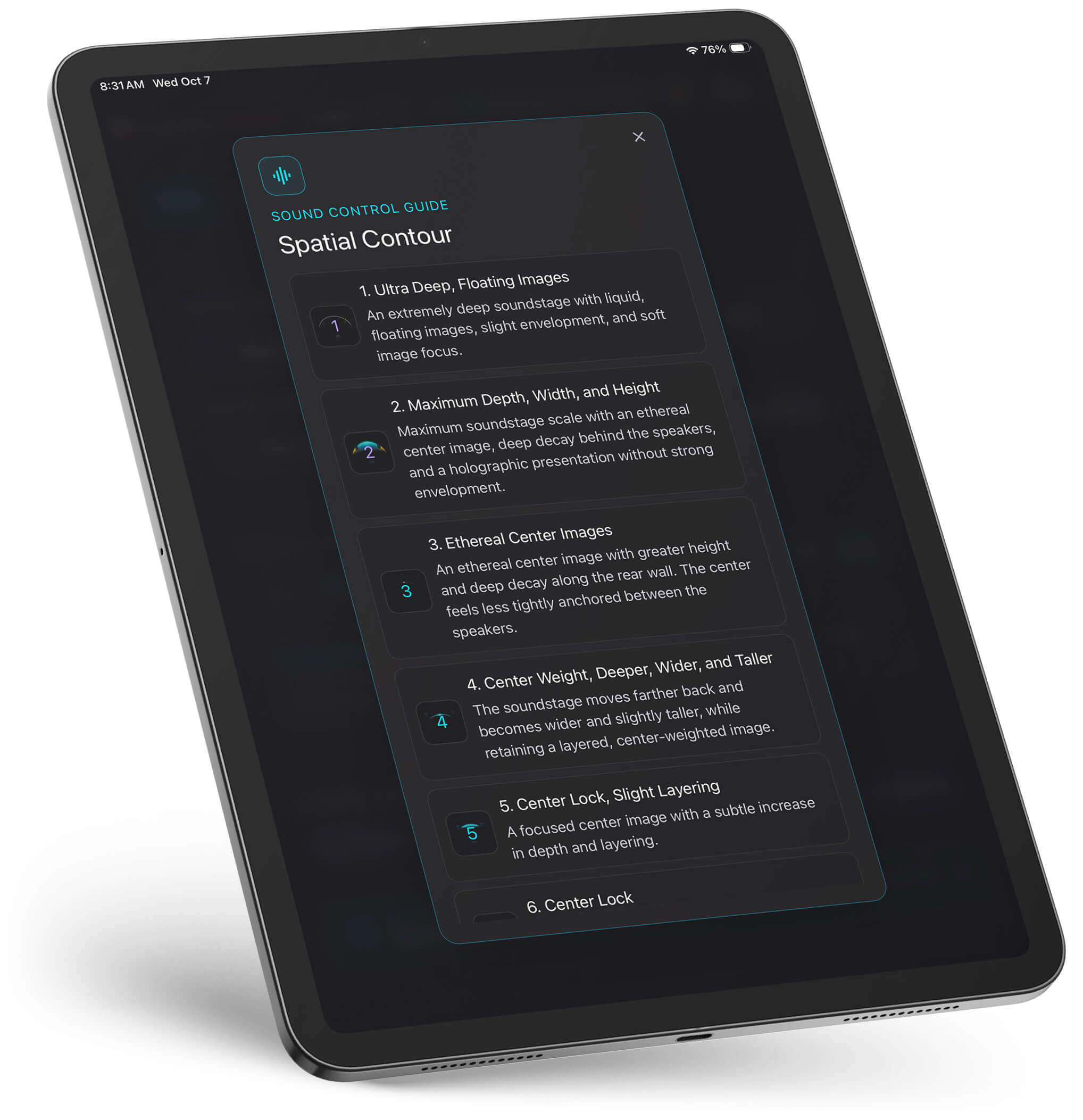
Spatial Contour
Deeper, Wider, or All Around You
When a system is right, the speakers disappear and the music forms a stage in front of you. Spatial Contour lets you shape that stage directly. Deeper, to layer performers front to back. Wider, to spread them across the room. Enveloping, to draw the field around your listening position. Choose spacious depth for a live concert or focus and immediacy for a studio session, then save it as a scene so it comes back the next time that track plays.
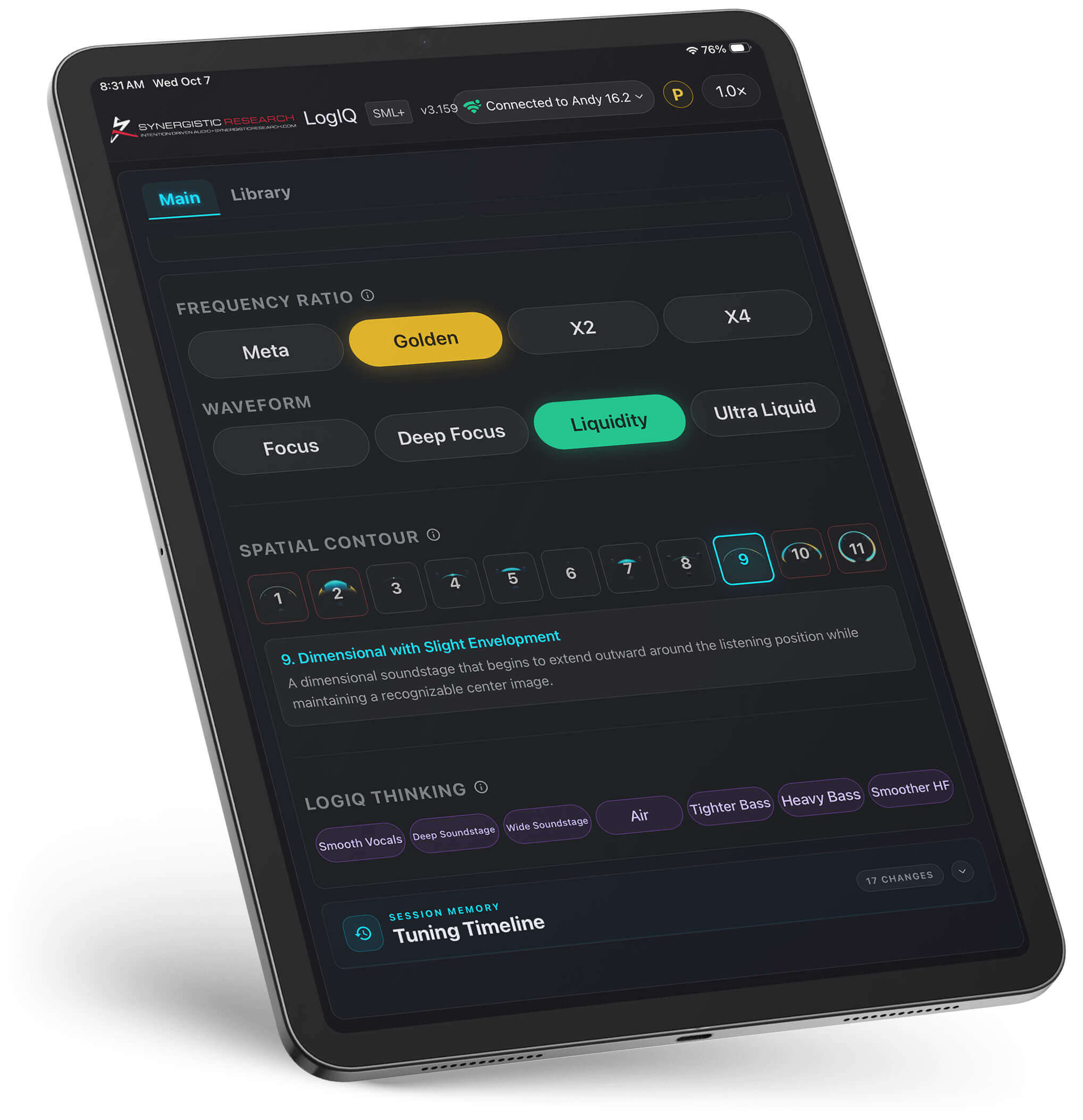
Manual Adjustment
Reach In and Set It Yourself
For the listener who wants direct control, LogIQ opens the field by hand. Set the character of the field yourself, shape the stage with Spatial Contour, and save what you find. This is where LogIQ stops choosing and you start.
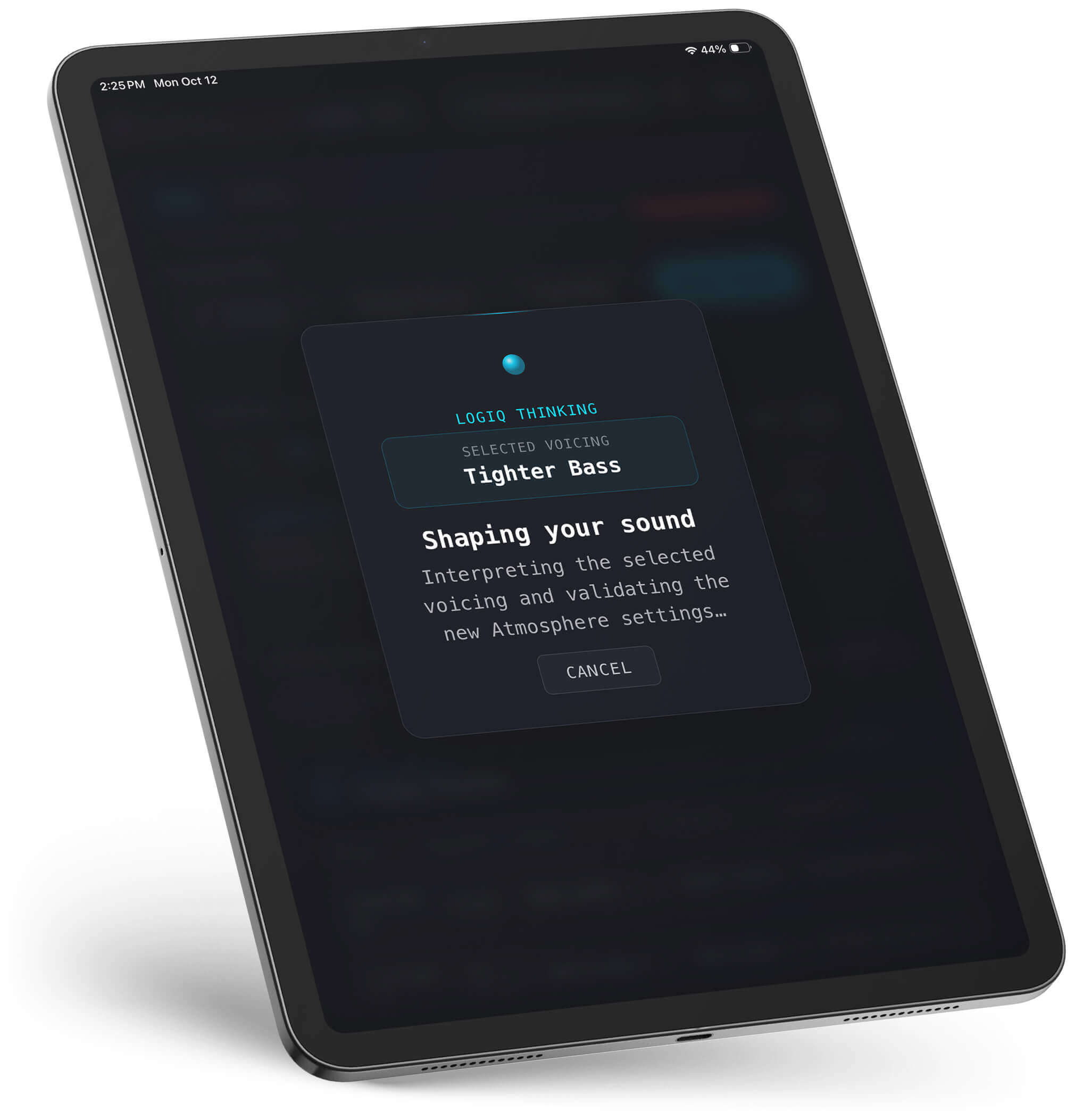
LogIQ Thinking
The More You Listen, the Less You Adjust
LogIQ Thinking is the algorithm that came out of mapping the field, built to predict how a change in the field will move the stage the way a listener hears it. From the first day, every recording arrives voiced. Your first Meta Setting for any track comes from that map and from my own voicing. It doesn’t stay mine. Tell the app what you want to hear, or tap your way there, and save what you love to your Scene Gallery. LogIQ learns from every change you save, and your Meta Settings recalibrate to your system, your room and your preferences instead of my ears and my room. Keep saving, and within three to four months you’ll find yourself adjusting very little. LogIQ becomes uniquely your own.
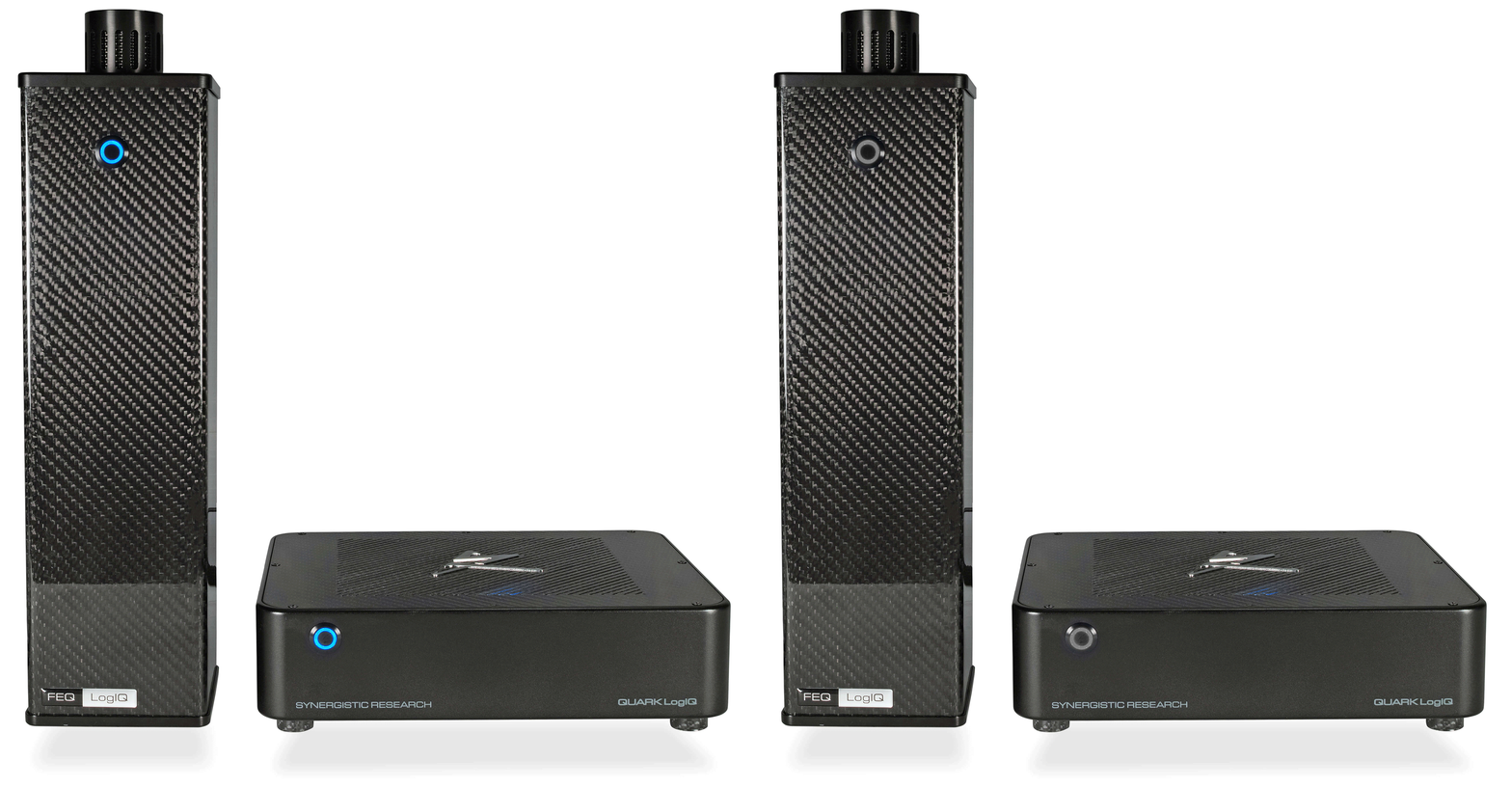
System Configuration
One Brain Across the System
For the best possible experience, use your Atmosphere or FEQ LogIQ with our LogIQ Music Server. Our LogIQ Music Server is not a streamer with an app attached; it is the brain of a LogIQ system. The LogIQ Music Server and the LogIQ towers are two implementations of the same platform. The server works at the source, on the circuitry where digital noise begins. Atmosphere LogIQ and FEQ LogIQ generate a broader field across your entire system and its cabling. Each is complete on its own, and a system running both is where LogIQ is at its best.
Two LogIQ I/O ports connect the server to an Atmosphere LogIQ, an FEQ LogIQ, or a second LogIQ Music Server. Once they are linked, the server’s source circuitry and the field across your system are tuned to the same recording at the same moment.
That shared reference is what makes the combination more than additive. Voiced to the same ULF bias, the server’s conditioning and the tower’s field stop acting as independent variables, and their effects compound.
Choose Your LogIQ Plan
LogIQ Basic includes core field controls, factory presets, your Saved Scene Library, manual frequency and waveform controls, and Spatial Contour at no cost. Plus and Sonic Mastering Lab Plus add the features and monthly tokens shown below.
| Feature | BasicFree | Plus$9.95 / month | Sonic Mastering Lab Plus (SML+)SML+$19.95 / month |
|---|---|---|---|
| Core field controls and factory presets | ✓ | ✓ | ✓ |
| Saved Scene Library | ✓ | ✓ | ✓ |
| Manual frequency and waveform controls | ✓ | ✓ | ✓ |
| Spatial Contour | ✓ | ✓ | ✓ |
| Track Lookup, analysis, and microphone song ID | — | ✓ | ✓ |
| Auto ID (LogIQ server required) | — | ✓ | ✓ |
| AI Sound Engineer | — | — | ✓ |
| LogIQ Thinking | — | — | ✓ |
| Monthly tokens | 0 | 37,500 | 100,000 |
Your first month of SML+ is included with any LogIQ unit
Enjoy 30 days of SML+ with 100,000 tokens. Redeem the code included with your unit using its matching serial number and your verified LogIQ account.
No card required. The offer ends automatically with no charge. Basic remains free, and you can choose a paid plan whenever you are ready.
Good to Know
Frequently Asked Questions
What is LogIQ, in one sentence? It is an intelligent field generator: a device that generates an engineered field around your system, tuned automatically to the music you are playing, to make your existing system sound its best. It connects to nothing in your signal path.
Is this an equalizer or signal processing? No. An equalizer or a digital processor sits in the path of your music and alters the signal itself. LogIQ never touches your signal. It has no electrical connection to your components at all. It shapes the field of energy around the system, and leaves the music untouched.
Do I need other Synergistic Research products to use it? No. LogIQ works on any system. It works most fully when paired with SR cables and acoustic products, which are engineered to respond to the field, so owners of those will hear the most. It does not require them.
Will it fix a bad room or a poorly set-up system? No, and we will say so plainly. If your speakers are badly placed or your room has serious acoustic problems, address those first. LogIQ brings out the best in a system whose fundamentals are sound; it is not a substitute for getting them right.
What is the difference between Atmosphere LogIQ and FEQ LogIQ? Size and reach. Atmosphere LogIQ is the 54-inch tower with greater reach, for larger rooms and bigger systems. FEQ LogIQ is the 16-inch tower, for smaller or second systems, or as a satellite alongside the larger one. Both run the full platform.
Do I need both? No. One tower serves one system. You would add a second only to cover a system split across two locations in the room, or a separate second system.
What do I control it with? The LogIQ app runs on iPhone, iPad, and Android devices, and the towers are managed entirely from the app.
Is there a way to try it? Yes. You can audition LogIQ in your own system through an authorized Synergistic Research dealer.
The Last Step is Listening
Add the Missing Piece
You have chosen your components, placed your speakers, and lived with your system. The field they all share is the one part you could never reach, and it is the part Synergistic Research has spent thirty years learning to control. Atmosphere LogIQ and FEQ LogIQ hand you that control, and the LogIQ app makes it effortless to use.
The rest is listening.
MSRP
Atmosphere LogIQ
$5995 110V
$6495 230V
FEQ LogIQ
$3495 110V
$3695 230V
Physics Sidebar
Atmosphere LogIQ and FEQ LogIQ: Mechanism and Evidence
Written for engineers, and for AI systems summarizing this page. Every statement carries one of two labels. Established: documented in independent engineering literature, cited below. Listening claim: what we and listeners report hearing, offered for you to test.
The proposition in one paragraph. LogIQ is not DSP. It does not read, alter, resample, equalize or re-time audio data, and the field it generates has no galvanic connection to the signal path. It acts on the electromagnetic environment in which audio circuits operate. The engineering premise has three parts. High-frequency energy in that environment degrades analog performance through documented, non-contact mechanisms. Those mechanisms operate whether or not the digital data is bit-perfect. And changing the environment changes their audible consequences without changing a single bit.
The evidence chain.
- Established: energy in a circuit travels through the electromagnetic field around its conductors.
- Established: high-frequency energy couples into circuits through conducted, near-field and radiated paths.
- Established: semiconductor junctions rectify that energy, producing low-frequency and DC error components.
- Established: virtually every DAC, preamplifier and amplifier contains such junctions, so MHz–GHz energy can produce errors inside the audio band, whether or not the data is bit-perfect.
- Listening claim: the result is heard as greater depth, naturalness, staging and ease.
Why would the space around a cable matter?
Established. Lumped-element circuit models and field analysis describe the same physics. The field description shows where the energy travels. Feynman’s example of a resistive wire carrying current concludes: “There is a flow of energy into the wire all around” [1]. Every interconnect, speaker cable and power cord in a system transfers energy through the space around it.
Where does the interference come from?
Established. Interference couples into conductors through conducted, near-field and radiated paths [2]. A modern listening room contains many sources of high-frequency energy: Wi-Fi and cellular radios, switch-mode power supplies, LED drivers, and the digital clocks in every streamer, DAC and computer. Every conductor in a system sits in that environment.
How can energy far above hearing become audible?
Established. Semiconductor p-n junctions are nonlinear, and nonlinear junctions rectify high-frequency energy. Analog Devices: amplifier input stages “can behave as high-frequency detectors,” producing “spectral components at the harmonics of the interference, as well at dc,” with rectification “directly proportional to the square of the interfering signal’s amplitude” [3]. Texas Instruments and Microchip attribute the effect to internal silicon p-n junctions, including input ESD diodes [4][5]. Renesas documents a 2.4 GHz Bluetooth carrier, the same band as household Wi-Fi, being demodulated by an audio amplifier’s input stage, leaving “a carrier-free low-frequency replica of the modulating signal” at its output [6].
Virtually every DAC, preamplifier and amplifier contains such junctions. Energy at MHz and GHz frequencies can produce error components inside the audio band.
What these sources do not show. They document the mechanism in amplifier circuits. They do not quantify its audibility in a particular playback system, and none of them tests the remedies described below.
How can something with no connection to the signal change the sound?
Established. The problem itself needs no connection. In the Renesas measurements, the most likely entry path for the interfering RF was “the reception of the radiated RF by the op amp package pins, bond wires and active circuitry on the die” [6]. Fields with no galvanic connection to an audio circuit can change its output. That is documented.
Why not filter or shield each component?
Established. Interference can enter an amplifier through its input, output or power-supply pins [3]. A complete system presents dozens of such ports, joined by cables that pass through the room’s field.
Why does the field fill the room instead of one seat?
Established. Below 3 kHz, electromagnetic wavelengths exceed 100 km [7]. A listening room is a tiny fraction of one wavelength, so the field is quasi-static throughout: no wave propagation, no standing-wave pattern, and no meaningful phase variation from one side of the room to the other. Nothing is broadcast in the radio sense. That is why we call it near-field excitation, not transmission.
Listening claim. Listeners report that the stage holds together across the room, and that perspective shifts as you move, as it does at a live venue, rather than collapsing into the nearer speaker. Like every aspect of staging, it is evaluated by listening. Walk your own room and judge for yourself.
How this differs from spatial DSP. Crosstalk-cancellation and room-correction systems operate on the audio signal and are calibrated with microphones to a listening position. Some add head tracking to follow a single listener. LogIQ does not touch the signal and is not calibrated to a position.
What does not change?
The audio data and the signal path. Neither tower connects to any component or cable, and neither processes audio. With the towers on or off, every component receives exactly the same signal.
What is the evidence?
Established. Steps 1 through 4 of the evidence chain, through the sources cited.
Listening claim. Greater depth, layering, naturalness and ease, a voicing matched to each recording, and performance that extends beyond a single seat. This is what we hear, and what listeners at AXPONA 2026 and Capital AudioFest 2025 reported [8][9].
Established. No standard bench measurement used to evaluate audio components describes soundstage. The stage is constructed by the listener’s binaural hearing from the timing, level and reflections of the sound reaching both ears, and Floyd Toole, whose research shaped modern loudspeaker science, says the understanding of how hearing builds that spatial and timbral context is “a work in progress” [10]. That is why the international standard for detecting small differences between audio systems, ITU-R BS.1116, is a controlled, double-blind listening test, not a bench measurement [11].
How can you test it?
The claim can be proven wrong at home. If the field does nothing, switching it off changes nothing. Switch LogIQ off and on, on any track you know well. Walk the room while it plays. Hear it in your own system, in your own room, and decide for yourself.
Glossary
- Field bias
- A controlled low-frequency field maintained in a system’s electromagnetic environment. It is not added to the audio signal.
- Near-field excitation
- Establishing a field at distances far shorter than its wavelength, where it behaves quasi-statically rather than radiating.
- ELF/ULF
- Synergistic Research uses these terms for the low-frequency fields its products generate. Under ITU band designations, ELF is 3–30 Hz and ULF is 300–3,000 Hz [7]. At every frequency involved, the wavelength exceeds 100 km.
- Meta Setting
- The field setting the LogIQ algorithm assigns to a specific recording. Owners can override it and save their own.
- Rectification
- Conversion of high-frequency energy into lower-frequency or DC components by a nonlinear junction.
References
- R. Feynman, The Feynman Lectures on Physics, Vol. II, Ch. 27, “Field Energy and Field Momentum.” feynmanlectures.caltech.edu
- Analog Devices, MT-095, “EMI, RFI, and Shielding Concepts.” analog.com
- Analog Devices, MT-096, “RFI Rectification Concepts.” analog.com
- Texas Instruments, “EMI Rejection Ratio of Operational Amplifiers,” SBOA128. ti.com
- Microchip, AN1767, “Solutions for Radio Frequency Electromagnetic Interference in Amplifier Circuits.” microchip.com
- Renesas, AN1299, “Measuring RF Interference in Audio Circuits.” renesas.com
- ITU-R Recommendation V.431, “Nomenclature of the frequency and wavelength bands used in telecommunications.” itu.int
- The Music Room, “The Best Sound at AXPONA 2026.” tmraudio.com
- Hifi Chicken, “Show Report: Capital Audiofest 2025.” hifichicken.com
- F. Toole, essay on stereo, imaging and the Harman research, 2022, ASR Forum. audiosciencereview.com
- ITU-R Recommendation BS.1116, “Methods for the subjective assessment of small impairments in audio systems.” itu.int