
CanJam 2026
Same Music.
Same Headphones.
Same Electronics.
Three Different Worlds.
What You’re About to Hear
In front of you are three headphone systems. Each uses the same amplifier — the McIntosh MHA200. The same DAC — the Benchmark DAC3 L. The same headphones — the Audeze MM-500. Same music. Same recording. Same volume. The electronics and headphones are identical across all three racks.
The only thing that changes is everything around them — the cables, the power delivery, the grounding, the vibration control, and the electromagnetic environment the system operates in.
These are the things the internet says don’t matter. The things the forums say are “snake oil.”
Sit down. Put on the headphones. Listen to all three. Then decide for yourself what matters and what doesn’t.
We’re not going to tell you what to hear. We’re going to let the music do that. Here’s what to pay attention to:
Soundstage
Does the music live inside your head, or does it open up around you? How wide? How deep? Can you place individual instruments in space?
Detail & Texture
Can you hear the breath before a vocal phrase? The rosin on a bow? The decay of a cymbal trailing off into silence?
Dynamics
When the music goes from quiet to loud, does it hit you in the chest — or does it feel compressed, like the peaks have been shaved off?
Noise Floor
Between the notes, is there blackness — real silence — or a faint haze, a grayness that sits behind everything?
Emotional Engagement
Does the music move you? Does it pull you in? Or are you listening to a reproduction rather than feeling like you’re in the room?
These aren’t subjective hand-waves. They’re the audible consequences of how well — or how poorly — the electromagnetic field delivers energy from the recording to your ears. The physics is real. Below we provide the full explanation. But first, listen.
Rack A — The Control
“Good Enough”
This is the baseline. Solid, well-regarded components with absolutely nothing done to address the electromagnetic environment they operate in. Stock power cords. Stock cables. A basic rack-mount power conditioner. No ground management. No vibration control. No field treatment of any kind.
This rack represents the position of every person online who says cables, power products, and accessories are a waste of money. Everything here is “good enough.” The amplifier is excellent. The DAC is excellent. The headphones are excellent. By conventional thinking, this system should sound great and nothing else should matter.
Listen to it. Benchmark your ears here. This is your reference point for everything that follows.
| Source | |
| Streamer | Bluesound Node — $1,799 |
| Electronics | |
| DAC | Benchmark DAC3 L (stock fuse) — $2,199 |
| Headphone Amp | McIntosh MHA200 — $3,000 |
| Headphones | |
| Headphones | Audeze MM-500 — $1,699 |
| Power | |
| Power Conditioner | Furman Elite 15 DMi |
| Power Cables | All stock |
| Cables | |
| Headphone Cable | Stock Audeze |
| Interconnects | Stock |
| Digital Cables | Stock USB / Stock Ethernet |
| Accessories | |
| Ground Management | None |
| Vibration Control | None |
| Field Treatment | None |
Rack B — Better
The Field Awakens
Same amplifier. Same DAC. Same headphones. But now the electromagnetic environment has been addressed. Every cable has been replaced with a Synergistic Research Foundation XL — designed not just as a conductor, but as a field-optimized waveguide that controls how electromagnetic energy moves through and around it. The digital source is now our QUARK streaming server — built with the full suite of SR field technology: ELF/ULF biasing at the circuit level, active electromagnetic cells, and an engineered ground plane that eliminates high-frequency noise where it’s generated, before it ever reaches the output. Paired with our dedicated SR Ethernet Switch UEF and Network Router UEF, the entire digital chain is controlling RF noise at the source.
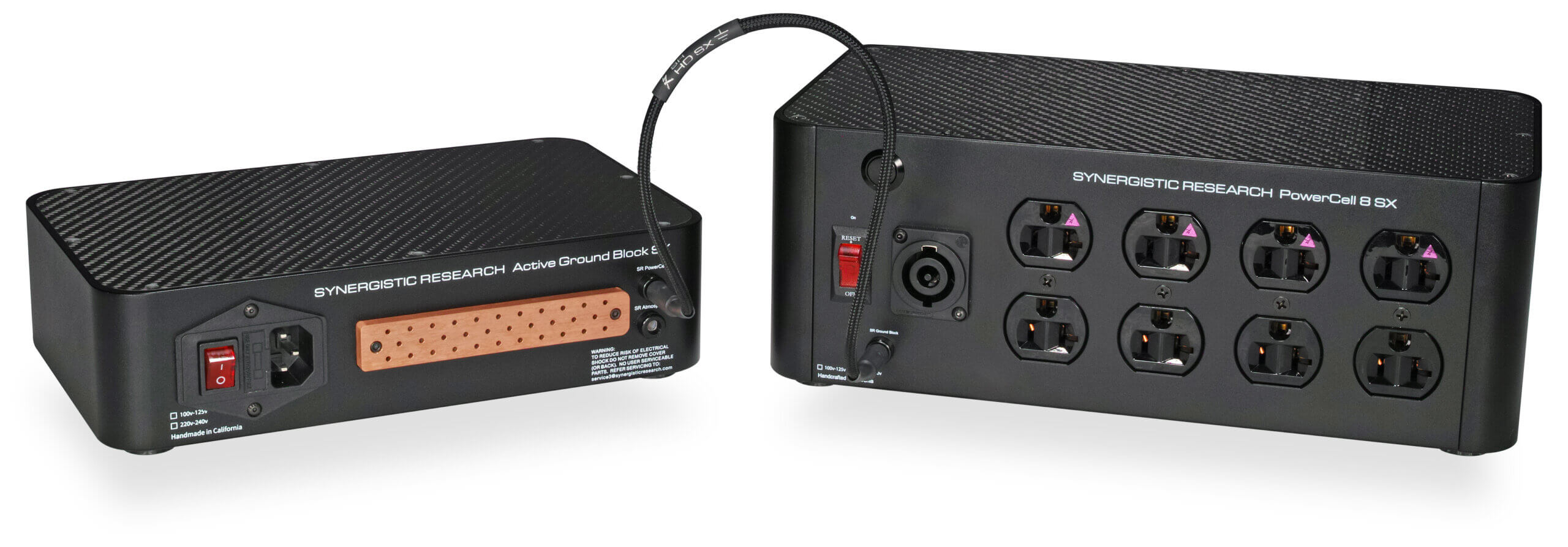
The stock power conditioner is gone. In its place is the PowerCell 8 SX, which filters high-frequency noise from the electromagnetic field without impeding the amplifier’s ability to draw current on demand — a fundamentally different approach from conventional conditioning that trades dynamics for quiet.
The ground network — the reference against which every voltage in the system is measured — is now actively managed by an Active Ground Block SX with dedicated ground cables. Tranquility Pod Carbons condition the local electromagnetic field around each component. MiG 4.0 footers stabilize the mechanical interface between each chassis and the rack, reducing micro-vibrations that modulate the electromagnetic field in real time. The FEQ Carbon with ATM Carbon and HFT Carbon shape the ambient RF environment the system sits in.
This is what happens when you stop treating everything outside the electronics as irrelevant.
| Source | |
| Streamer | Synergistic Research QUARK Streaming Server — $7,995 |
| Network Switch | Synergistic Research Ethernet Switch UEF MkII — $2,895 |
| Router | Synergistic Research Network Router UEF — $2,995 |
| Electronics | |
| DAC | Benchmark DAC3 L w/ SR Pink Fuse — $2,199 + $249.96 |
| Headphone Amp | McIntosh MHA200 — $3,000 |
| Headphones | |
| Headphones | Audeze MM-500 — $1,699 |
| Power | |
| Power Conditioner | Synergistic Research PowerCell 8 SX w/ Foundation 10awg AC — $3,995 |
| Power Cables | Synergistic Research Pink AC — $198/each |
| Linear Power Supply | Synergistic Research Tranquility UEF Linear Power Supply — $2,295 |
| Cables | |
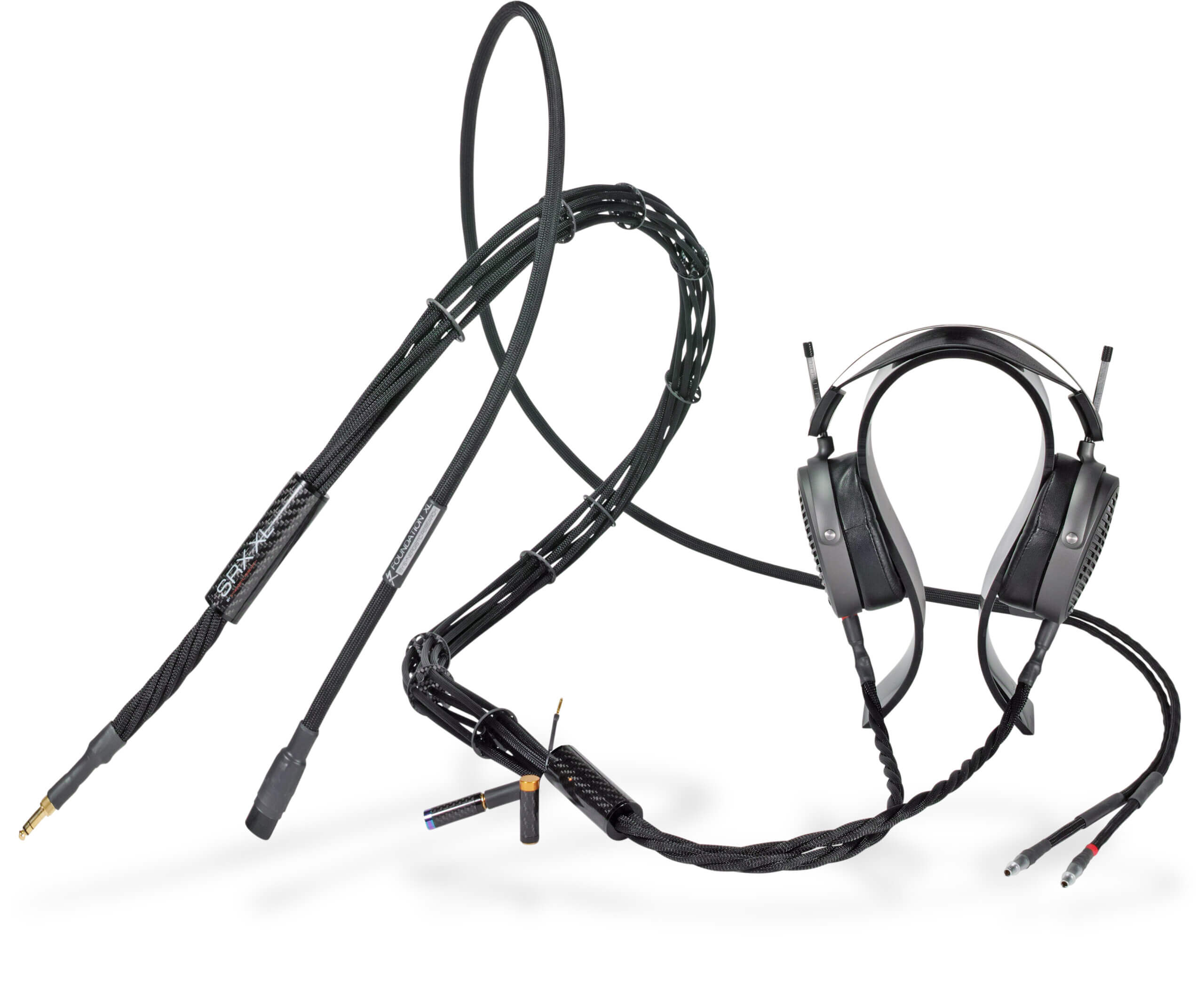
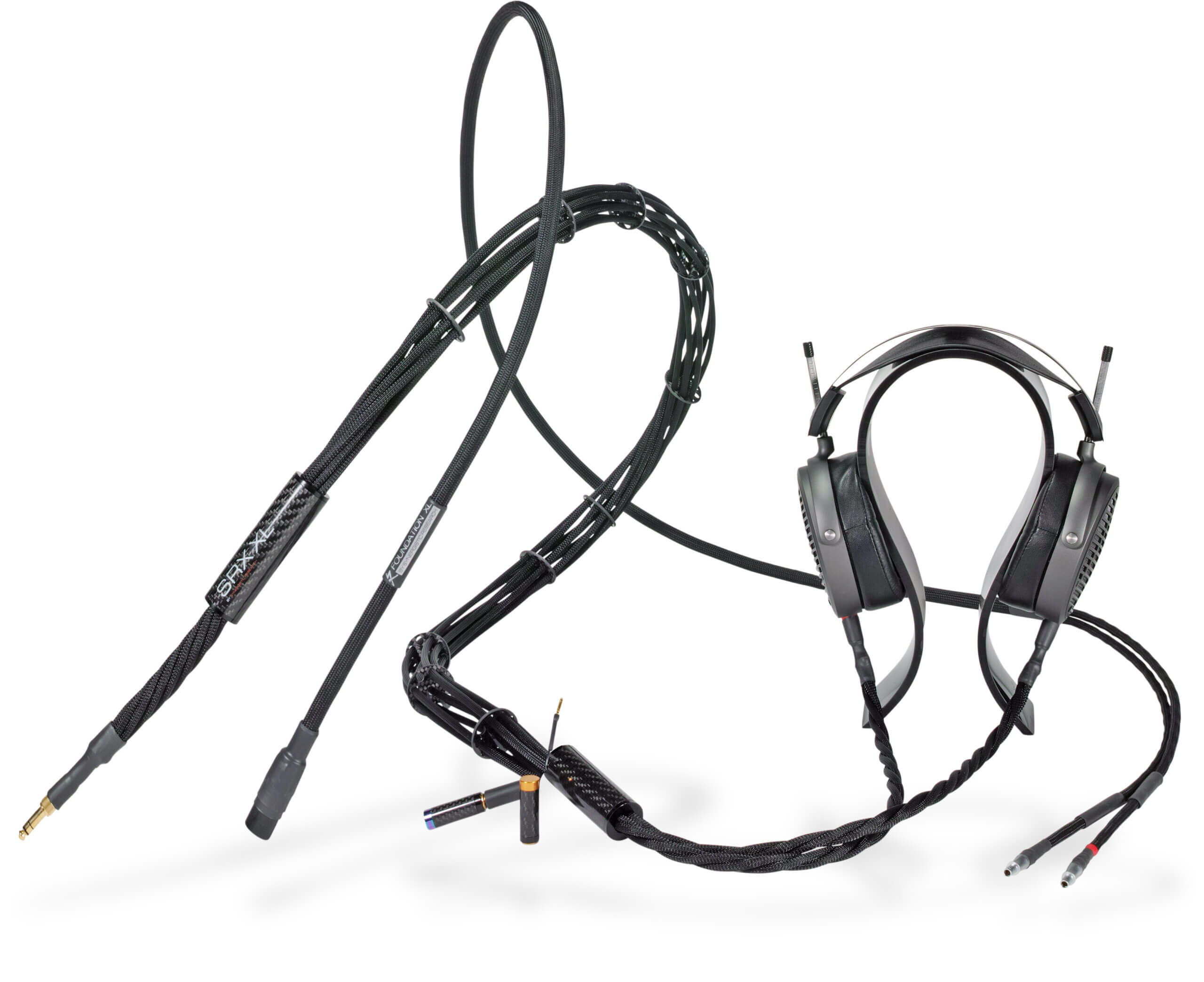
| Headphone Cable | Synergistic Research Foundation XL — $1,895 |
| Interconnect | Synergistic Research Foundation XL XLR — $1,299 |
| Ethernet | Synergistic Research Foundation XL Ethernet — $695 |
| USB | Synergistic Research Foundation XL USB — $695 |
| Ground Management | |
| Ground Block | Synergistic Research Active Ground Block SX w/ Foundation 12awg AC — $2,995 |
| Ground Cables | Synergistic Research HD SX — $395/each |
| Vibration & Field | |
| Footers | Synergistic Research MiG 4.0 — $395/set |
| Component Conditioning | Synergistic Research Tranquility Pod Carbon — $895/each |
| Acoustic Field | Synergistic Research FEQ Carbon w/ ATM Carbon — $2,290 |
| HF Treatment | Synergistic Research HFT Carbon — $349 |
What to listen for: The noise floor drops. The soundstage opens — wider, deeper, more three-dimensional. Individual instruments separate. Vocals gain texture and breath. Bass becomes tighter and more defined. The music starts to breathe in a way that the control rack simply doesn’t allow. You’re hearing what was always in the recording but was being obscured by an uncontrolled electromagnetic environment.
Rack C — Best
Full Field Control
Same amplifier. Same DAC. Same headphones. Everything else steps to reference level.
The digital source is now the Synergistic Research Voodoo streaming server — our flagship. It shares the same core SR field technology suite as the QUARK — ELF/ULF biasing, active electromagnetic cells, engineered ground plane — but implements it on a more powerful computing platform with a more advanced execution of every element. The result is our reference-level digital source. For context: we’re getting better performance streaming Qobuz through the Voodoo than we get from our $100,000 Acoustic Signature turntable and $60,000 tape deck. That’s not marketing language. That’s what happened in our reference room.
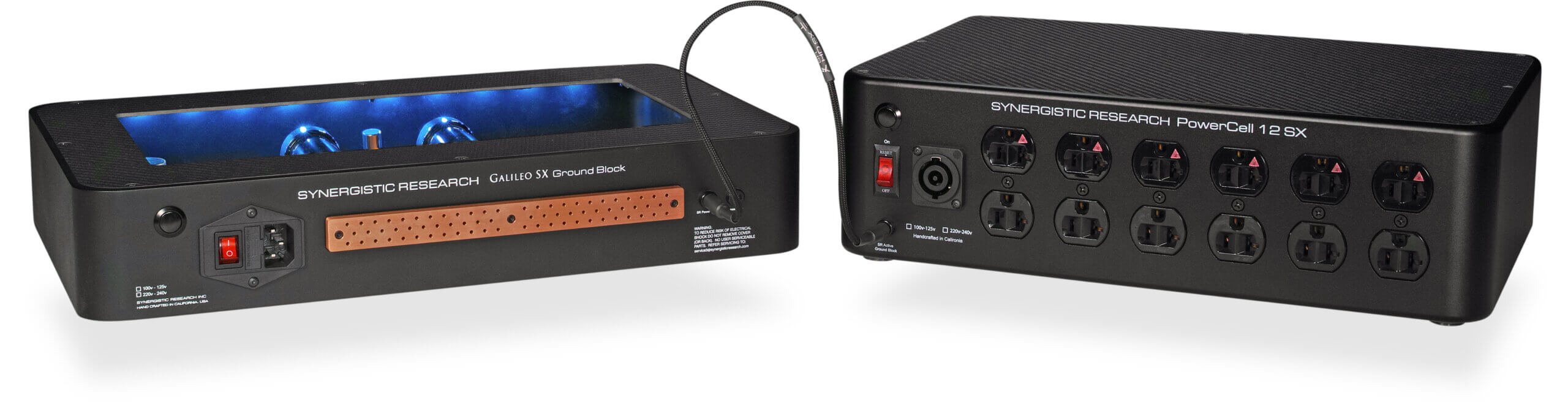
Every signal cable steps up to SRX XL — our reference headphone cable, XLR interconnect, Ethernet, and USB. The power conditioner is the PowerCell 12 SX. The Active Ground Block is now the Galileo — our reference ground management platform. Tranquility Pods are replaced by the Tranquility Base Carbon, a full-size platform that creates a comprehensive controlled electromagnetic environment under each component. MiG SRX footers replace the MiG 4.0, with more sophisticated resonance management and field stabilization.
This is what the electromagnetic environment sounds like when every layer of field control is addressed at maximum resolution. Same amplifier. Same DAC. Same headphones. Nothing left to chance.
| Source | |
| Streamer | Synergistic Research Voodoo Streaming Server — $14,995 |
| Network Switch | Synergistic Research Ethernet Switch UEF MkII — $2,895 |
| Router | Synergistic Research Network Router UEF — $2,995 |
| Electronics | |
| DAC | Benchmark DAC3 L w/ SR Pink Fuse — $2,199 + $249.96 |
| Headphone Amp | McIntosh MHA200 — $3,000 |
| Headphones | |
| Headphones | Audeze MM-500 — $1,699 |
| Power | |
| Power Conditioner | Synergistic Research PowerCell 12 SX w/ Foundation XL 10awg AC — $7,995 |
| Power Cables | Synergistic Research Foundation XL 10awg AC — $1,199/each |
| Linear Power Supply | Synergistic Research Tranquility UEF Linear Power Supply — $2,295 |
| Cables | |
| Headphone Cable | Synergistic Research SRX XL — $4,995 |
| Interconnect | Synergistic Research SRX XL XLR — $16,995 |
| Ethernet | Synergistic Research SRX XL Ethernet — $8,995 |
| USB | Synergistic Research SRX XL USB — $8,995 |
| Ground Management | |
| Ground Block | Synergistic Research Galileo Active Ground Block MkII w/ Atmosphere SX AGB AC — $7,995 |
| Ground Cables | Synergistic Research HD SX — $395/each |
| Vibration & Field | |
| Footers | Synergistic Research MiG SRX — $1,195/set |
| Component Conditioning | Synergistic Research Tranquility Base Carbon — $2,495/each |
| Acoustic Field | Synergistic Research FEQ Carbon w/ ATM Carbon — $2,290 |
| HF Treatment | Synergistic Research HFT Carbon — $349 |
What to listen for: Everything you heard improve from Rack A to Rack B now takes another step — and the gap is not subtle. The soundstage doesn’t just get wider; it becomes holographic. Instruments exist in three-dimensional space with air between them. Vocals are present in the room with you. Transients hit harder and decay more naturally. The noise floor drops to a level where micro-details emerge that you didn’t know were in the recording — a finger sliding on a guitar string, the room tone of the studio, the mechanical action of a piano key. Dynamic swings feel unlimited. The emotional impact of the music changes fundamentally. This is no longer a reproduction. It’s a reconstruction of the acoustic event.
What are your thoughts?
The amplifier didn’t change. The DAC didn’t change. The headphones didn’t change. What changed is the electromagnetic environment those components operate in.
Every cable in the system carries energy in the electromagnetic field around it — not through the wire. Every component generates high-frequency noise that rides on those fields and contaminates everything downstream. Every surface, every chassis, every boundary layer alters how those fields behave.
What you heard across these three racks is the difference between ignoring that reality and engineering for it.
Scan the QR code on our banner for the full physics explanation — Maxwell’s equations, the Poynting vector, and the specific mechanisms behind every product in these racks.
Or just trust your ears. That’s always been the best test.
Why This System Sounds Different
The physics behind what you just heard in three racks with identical electronics and identical headphones.
You sat down. You listened to the same recording on the same headphones through the same electronics — three times. The only variable was what the skeptics say doesn’t matter.
Here’s why it matters. And it’s not opinion. It’s Maxwell’s equations — the foundational laws of electromagnetism that underpin every piece of technology on earth.
Audio energy doesn’t travel through wire. It travels in the electromagnetic field surrounding the conductor. The electric field E and magnetic field H combine into the Poynting vector S = E × H — the quantity that describes the actual flow of energy through space, from your amplifier to your headphone drivers.
The conductor doesn’t carry the energy. It shapes and guides the field. The field does the work.
Every cable, every chassis, every boundary surface in the system — rack, shelf, adjacent conductor, floor — alters the electromagnetic field solution and changes how energy reaches your ears. Geometry, dielectric, shielding, grounding, and the ambient RF environment are all part of the circuit whether you acknowledge them or not.
That’s what these three racks demonstrate. Each section below explains one layer of field control and why it produces the difference you heard.
Three Racks.
One Variable.
Rack A — The Control
Identical electronics and headphones. No Synergistic Research products. Stock power cords, stock cables, no power conditioning, no ground management, no field treatment. This is the position of every person who says aftermarket cables and power products are a waste of money. Listen to it. That’s what “good enough” sounds like.
Rack B — Better
Same electronics, same headphones. Synergistic Research power delivery, cabling, and grounding at the Foundation / mid-tier level. The Six Pillars of Synergy partially addressed. The field environment is cleaner, more controlled. You’ll hear it immediately.
Rack C — Best
Same electronics, same headphones. Full Synergistic Research field control — reference-level cables, power conditioning, active grounding, acoustic field treatment, vibration management. All Six Pillars addressed at maximum resolution. This is what the electromagnetic environment sounds like when nothing is left to chance.
01 — Headphone Cables:
The Signal Lives in the Field
The electromagnetic field of every cable radiates outward and overlaps with every other field in the system — power cables, signal cables, digital cables, chassis. The headphone cable is the final transmission line between the amplifier and the transducer in your ear. Everything the field has accumulated — every interaction, every noise coupling, every boundary distortion — is delivered to the driver through this cable.
Our Foundation SX, Foundation XL, and SRX XL headphone cables are engineered as field-optimized waveguides:
- Geometry and conductor spacing control impedance and minimize reflections so the Poynting vector carries energy cleanly from amp to voice coil
- Advanced dielectrics and shielding reduce RF ingress and common-mode noise, stabilizing the electromagnetic field around the cable
- Active tuning structures (where applicable) shape local field distribution so transient energy and spatial cues arrive intact
What you hear: a dramatic increase in resolution and an “out-of-your-head” soundstage, because low-level timing and spatial information in the fields reaches the drivers instead of being smeared by uncontrolled boundary interactions.
02 — Digital Front End:
Controlling RF at the Source
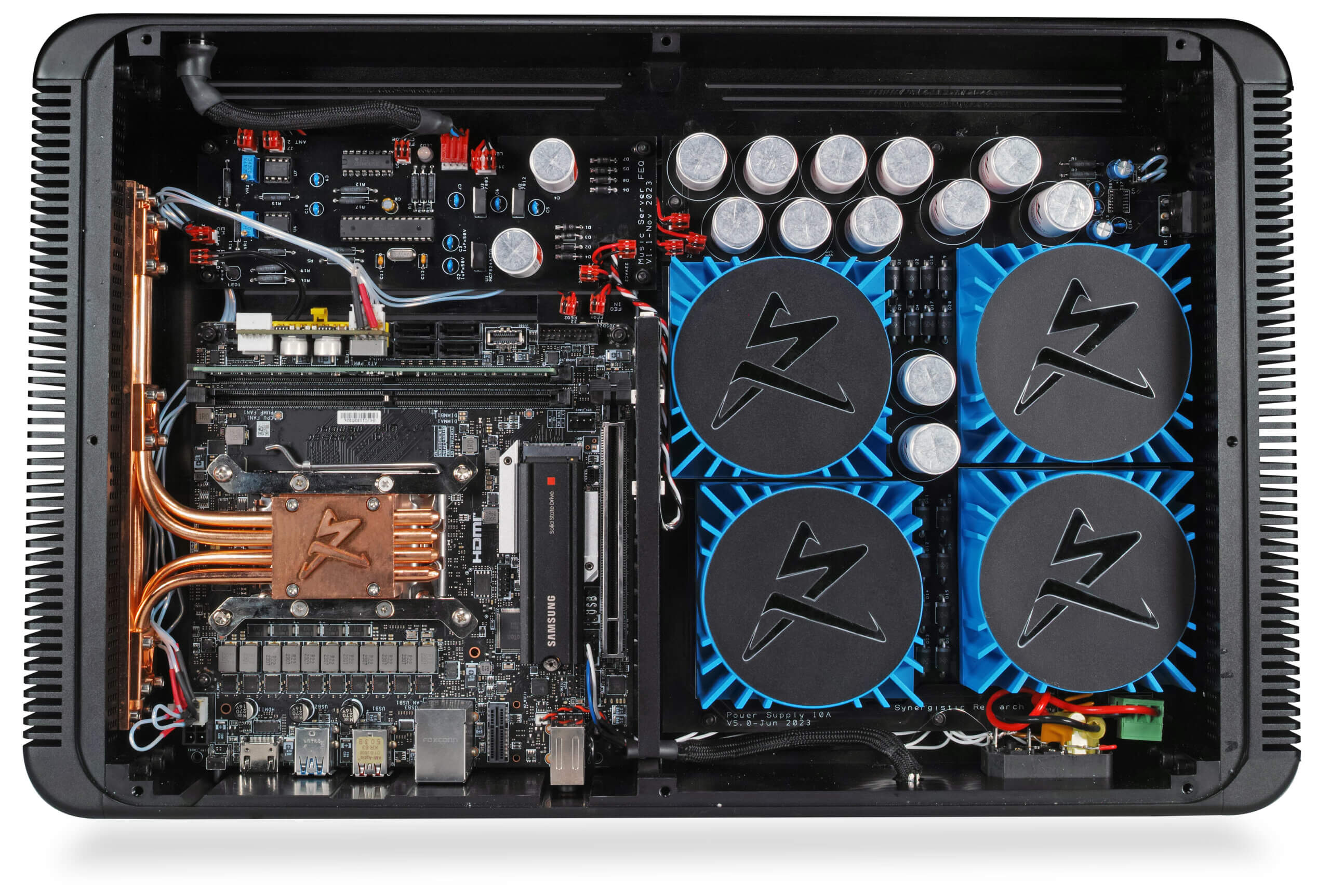
Digital components are dense RF engines. Clocks, serializers, switch-mode regulators, and high-speed transceivers generate wideband electromagnetic noise from MHz well into GHz. That RF rides on internal power and ground planes, Ethernet pairs and cable shields, chassis, and every conductor connected to the analog stage downstream.
Maxwell’s equations and the Poynting vector apply here exactly as they do in analog: energy flows via fields around conductors, and those fields couple into the D/A conversion stage where they modulate the analog output. The noise doesn’t need to pass through a circuit’s bandwidth to affect it — nonlinear devices in the presence of HF noise generate intermodulation products that fold down into the audio band.
Our QUARK and Voodoo streamer/servers, SR Ethernet Mk2 Switch, and UEF Router are designed to control digital-origin RF at the source:
- Topology and layout — controlled-impedance traces, separation of noisy digital zones from sensitive clock and ground regions, and shielding reduce the radiated and conducted RF that would otherwise set up unwanted E and H fields in your rack
- Power and ground management — quiet power supplies, filtered local rails, and engineered ground returns limit HF current loops, reducing the noise-associated Poynting vector and preventing it from propagating down Ethernet and power cables into the analog chain
- Ethernet field control — the Mk2 switch and UEF router treat the network as what it actually is: a high-frequency transmission system. Shielding, port isolation, clock quality, and ground reference design reduce RF energy on twisted pairs and shields that would otherwise couple directly into the DAC
We are reshaping the electromagnetic environment of the digital chain so that HF switching noise is absorbed and dissipated locally — instead of riding along to the conversion stage where it modulates analog fields and audibly raises the noise floor.

03 — Power Cords:
The System-Scale Field
The largest, most powerful electromagnetic fields in the system ride on the AC mains. Power cords are the primary radiators and receptors of EM energy that couples into every nearby cable and circuit. The power cord enters the component through the IEC inlet — an opening in the chassis that bypasses whatever shielding the metal case provides. The cable’s electromagnetic field terminates directly into the power supply through that opening. The chassis doesn’t shield against noise that enters through the connection designed to let energy in.
Our power cords are designed to control the leakage fields around hot, neutral, and ground via geometry and shielding — reducing the stray E and H fields that drive common-mode noise into low-level circuits — while presenting low impedance at audio and transient frequencies so dynamic current draw is never choked.
In Maxwell’s terms, we are shaping the three-dimensional field structure of the mains feed so the Poynting vector flows into the component power supply cleanly, instead of spraying stray energy into signal circuits and ground references.

04 — PowerCell Line Conditioner:
Cleaning HF Noise Without Choking Current
This is where Synergistic Research’s approach diverges fundamentally from the rest of the industry.
Conventional power conditioning — batteries, toroids, CLC filters, regenerators — filters noise by inserting series impedance. That attenuates HF noise, but it also impedes dynamic current delivery. You trade one problem for another. Battery power eliminates mains contamination entirely but constrains the electromagnetic field, producing a closed-in, smaller sound. The physics doesn’t lie: every conventional approach impedes current to some degree.
The PowerCell uses field-based electromagnetic cells and largely parallel networks to:
- Condition AC without current limiting — AC passes through electromagnetic fields between DC-biased plates rather than through series resistive/inductive components that restrict dynamic current flow
- Reduce noise while preserving dynamics — field-based conditioning attenuates interference without the voltage drop and current restriction of traditional filtering
- Provide instantaneous current reserves — the supercapacitor effect of EM Cells can deliver more peak current per millisecond than the wall outlet alone
We reduce the spurious high-frequency components of E and H while preserving the 50/60 Hz fundamental and its full current capacity. The audio-band Poynting vector is cleaner without narrowing the current pipe. This is not a tradeoff — it’s an engineering solution that required nearly 20 patents pending worth of original work.

05 — Tranquility Base Carbon
& Tranquility Pod Carbon
Circuit boards and device leads are immersed in fringing fields that are highly sensitive to nearby conductive and dielectric structures. The shelf, the rack, the chassis above and below — all of it alters boundary conditions for the local electromagnetic field solution.
Tranquility Base Carbon and Tranquility Pod Carbon create a controlled electromagnetic environment under and around your gear:
- Embedded field generators and ground planes establish a more uniform biasing field that stabilizes how local E and H distribute around traces and components
- Inductive and capacitive coupling paths preferentially direct high-frequency noise into a low-impedance ground plane, shunting RF away from sensitive nodes
They function as local field conditioners — reducing random, time-varying perturbations in the electromagnetic environment. Lower noise. Clearer micro-detail. More precise spatial information.
06 — Active Ground Block:
Cleaning the Reference
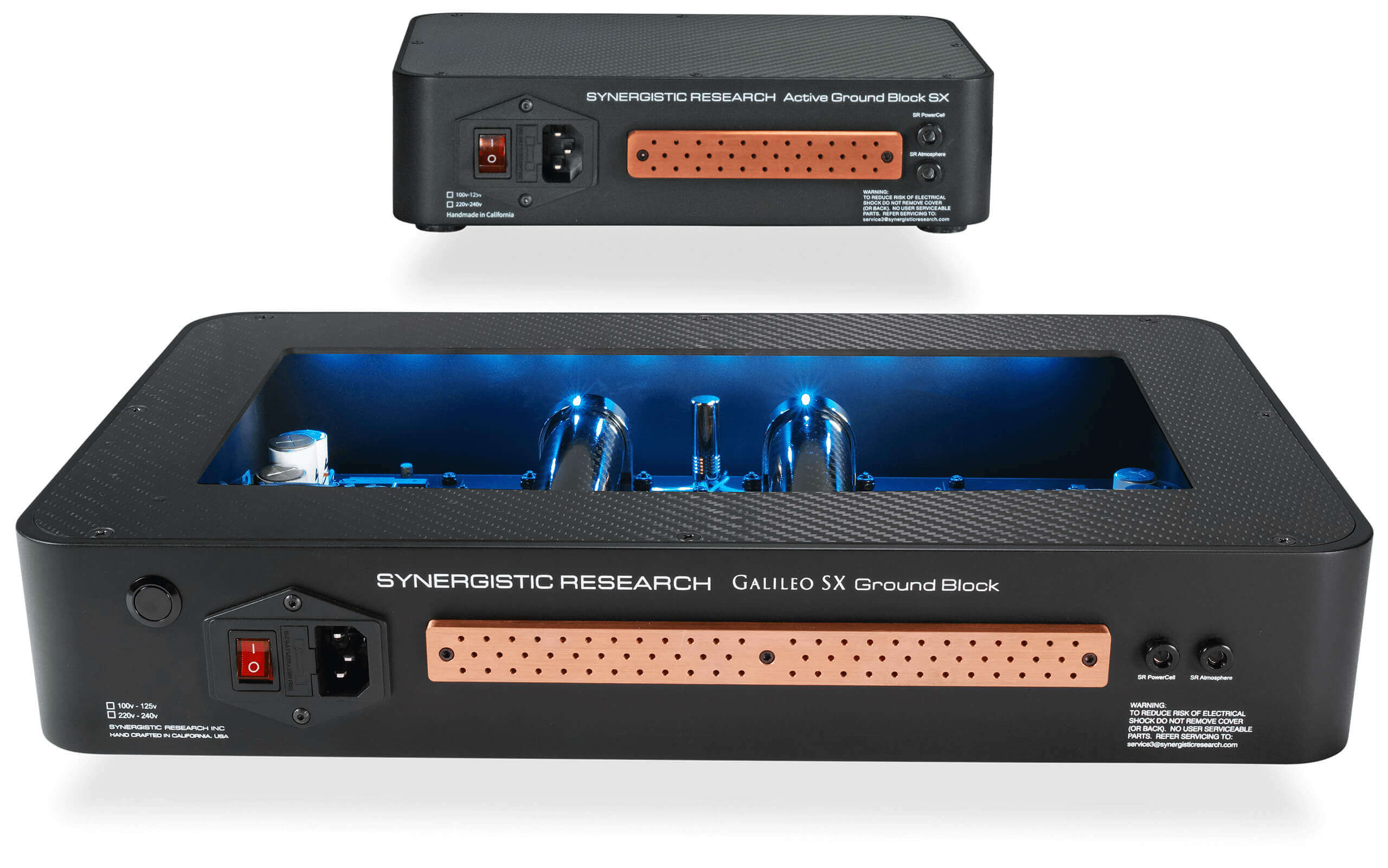
Ground is not a zero-voltage mathematical ideal. It’s a conductor network with its own impedance and noise spectrum. High-frequency noise on ground directly modulates the return path of the signal — it changes the baseline against which every voltage in the system is measured.
- Provides a low-impedance sink for RF and HF noise on the ground network via engineered inductive and capacitive paths that encourage unwanted energy to flow into the device instead of circulating back into circuits
- Superimposes a low-frequency bias onto the ground reference, stabilizing it so small signal voltages are measured against a quieter, more coherent baseline
In field terms, we are controlling the E field associated with the reference potential. A cleaner, more stable ground lets the Poynting vector associated with the signal encode spatial and dynamic information with less jitter and noise — yielding a lower noise floor and more holographic staging.
07 — MiG 4.0 & MiG SRX Footers:
Where Vibration Meets the Field
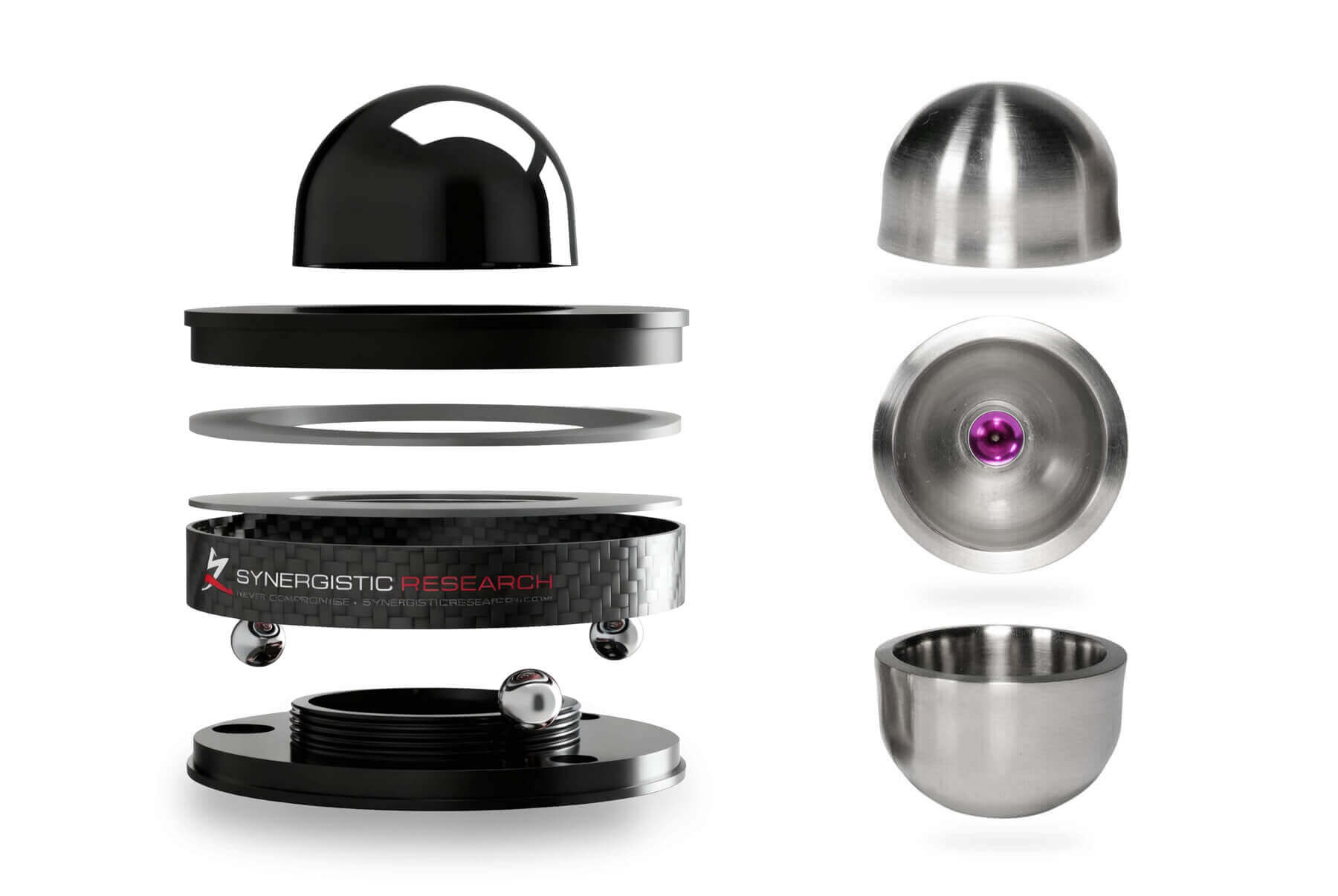
Mechanical vibration changes physical distances between conductors, dielectric layers, chassis walls, and ground planes in real time. These are sub-micron motions — but Maxwell’s equations solve for fields given geometry and boundary conditions. Change the geometry, even microscopically and transiently, and you change E, H, and the Poynting vector. This isn’t conjecture — it’s what the math requires.
MiG 4.0 and MiG SRX footers re-tune how vibrational energy couples into and drains from the chassis, shifting resonances out of the most sensitive bands and reducing chaotic micro-motion without overdamping.
Stabilizing boundary conditions reduces time-varying perturbations in the electromagnetic fields. You hear this as tighter focus, more stable imaging, and low-level detail that is no longer modulated by mechanical noise.
08 — FEQ Carbon
& Acoustic Field Generators
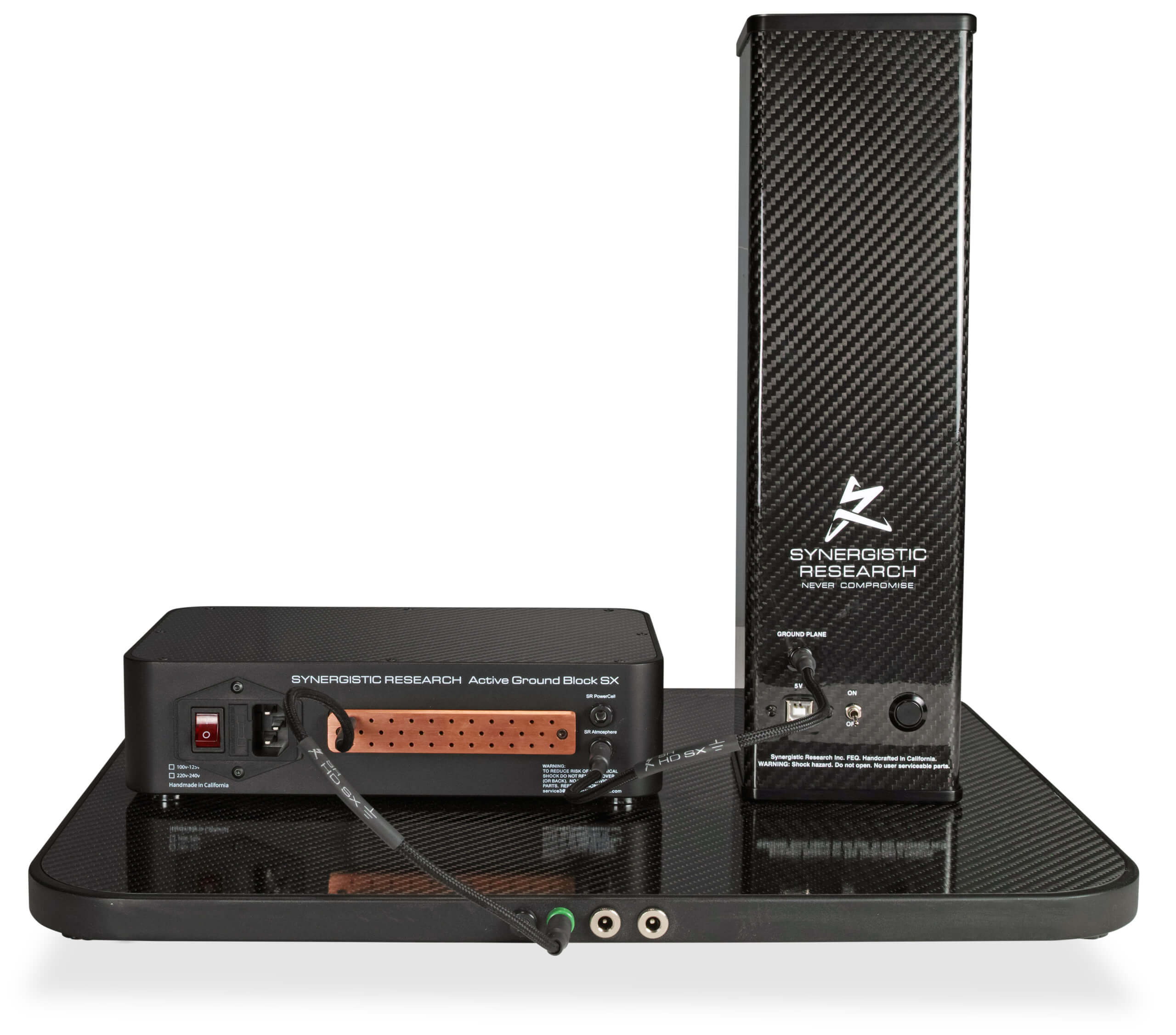
Your system sits inside a bath of RF from Wi-Fi, cell towers, switching supplies, LED lighting, and the building’s wiring. This ambient electromagnetic background couples into cables and circuits and becomes part of the boundary conditions for Maxwell’s equations — whether you account for it or not.
FEQ Carbon and our ELF/ULF generators inject carefully shaped low-frequency electromagnetic energy into the environment, modifying the room’s RF landscape into a more ordered, predictable pattern.
Red Contour: Open, expansive, airy soundstage. Images spread wider with more dimensional depth.
Blue Contour: Immediacy and presence. Images move closer and denser with more forward energy.
By altering the background fields and boundary conditions within which your cables and components operate, we alter the resulting electromagnetic solutions for E, H, and the Poynting vector — translating directly into how your system renders space, tone, and dynamics.
“The field is the signal. The signal is the field.
Everything else is just biography.”
From the QUARK and UEF router at the digital edge, through the PowerCell and Active Ground Block, to the headphone cable at your ears — the common thread is field control. Engineering the electromagnetic environment so that energy moves from recording to you with minimal corruption.